
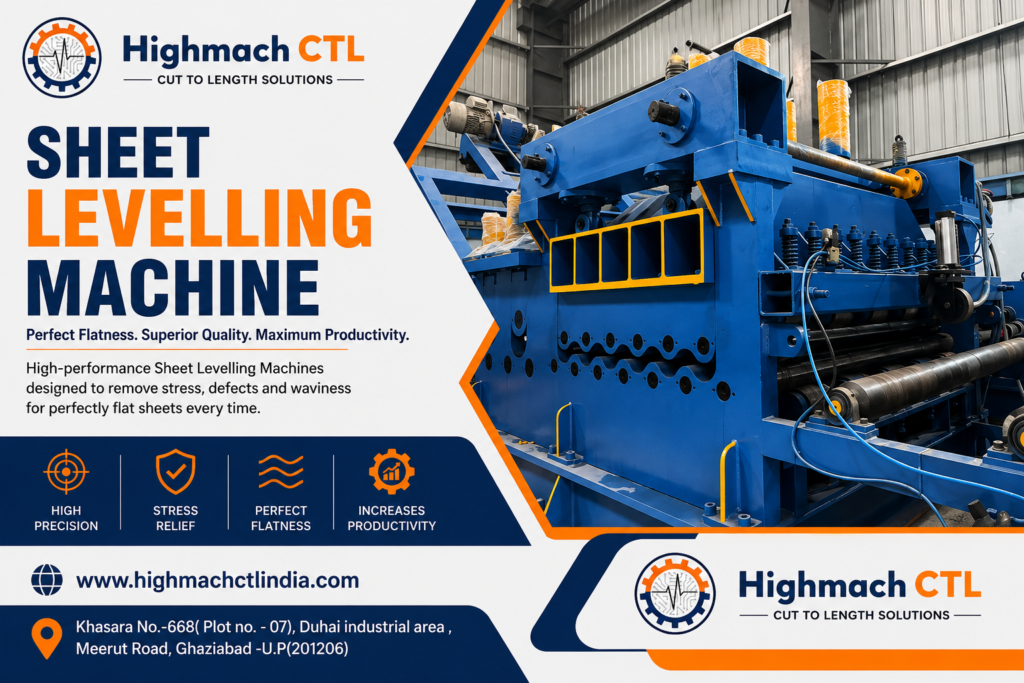
A Sheet Levelling Machine flattens metal coils and sheets by passing them through a series of offset rollers that apply controlled pressure. This removes internal stress, coil set, edge waves, and center buckle left over from rolling or coiling, producing a flat, dimensionally accurate sheet ready for cutting, bending, or stamping. Levellers are commonly built in 2Hi, 4Hi, and 6Hi roller configurations, chosen based on material type, thickness, and required flatness tolerance.
Why Sheet Flatness Matters in Metal Processing
Every coil of steel, stainless steel, or aluminum carries internal stress from the rolling and coiling process. When that coil is uncoiled, it doesn’t sit flat — it springs back into curls, waves, or buckles. If this unevenness isn’t corrected before cutting or fabrication, it shows up later as:
- Inaccurate blank dimensions
- Poor weld and bend quality
- Higher scrap and rework rates
- Inconsistent stamping and forming results
This is exactly why manufacturers install a sheet levelling machine ahead of shearing, blanking, or slitting operations — it’s the step that turns an inconsistent coil into a predictable, workable sheet.
How a Sheet Levelling Machine Works
A leveller works on a simple but precise principle: repeated, alternating flexing. The sheet passes between two rows of rollers arranged in a staggered, overlapping pattern. As the material moves through, each roller bends it slightly in the opposite direction of the previous one.
This alternating bending action does three things:
- Redistributes internal stress evenly across the sheet’s cross-section, rather than leaving it concentrated at the edges or center.
- Reduces the sheet’s natural curvature in progressively smaller increments until it settles flat.
- Equalizes elongation across the width of the sheet, preventing wavy edges or a bowed center.
Operators adjust roller gap, pressure, and entry/exit tension based on the sheet’s thickness and material grade — thinner or softer metals need lighter pressure, while thicker or harder alloys require deeper roller penetration.
Types of Sheet Levelling Machines
Levellers are generally classified by their roller configuration. Each type suits a different balance of precision, material thickness, and production speed.
| Type | Roller Arrangement | Best Suited For | Key Advantage |
| 2Hi Leveller | Two rollers, simple pass | Light-gauge sheets, basic straightening | Compact, cost-effective, easy maintenance |
| 4Hi Leveller | Backup rollers support two working rollers | Medium-thickness HR/CR coils | Higher rigidity, reduced roller deflection |
| 6Hi Leveller | Multiple work and backup rollers | High-precision, high-volume lines | Superior flatness accuracy, handles wider thickness range |
How to read this table for your use case:
- Choose 2Hi if you’re processing thin sheets at moderate speed with a limited budget.
- Choose 4Hi if you need better rigidity for cold-rolled or hot-rolled coils without a major cost jump.
- Choose 6Hi if your line demands tight flatness tolerances at high throughput — common in automotive, appliance, and precision fabrication industries.
Common Sheet Defects a Leveller Corrects
- Coil set – the residual curl from being wound on a coil
- Edge wave – rippling along the sheet edges
- Center buckle – bulging in the middle of the sheet
- Camber – a slight sideways curve along the length
- Cross bow – curvature across the sheet’s width
A properly calibrated leveller addresses all of these in a single pass, which is why it’s positioned early in most cut-to-length and slitting lines.
Key Factors to Consider When Buying a Sheet Levelling Machine
1. Material Type and Thickness Range
Mild steel, stainless steel, and aluminum each respond differently to roller pressure. Confirm the machine’s rated thickness and material range matches your production mix — not just your current job, but likely future orders too.
2. Roller Configuration and Build Quality
More rollers generally mean finer control and better flatness, but also higher cost and larger footprint. Match the configuration to your tolerance requirements rather than over-specifying.
3. Sheet Width and Production Speed
Ensure the machine’s working width comfortably covers your widest coil, and that its line speed integrates with your existing decoiler, shearing, or CTL setup without creating a bottleneck.
4. Adjustability and Automation
Machines with fine-tuned, easily adjustable roller gap settings reduce setup time between jobs and minimize operator error — especially valuable in mixed-material production environments.
5. Frame Strength and Durability
A rigid, heavy-duty frame prevents roller deflection under load, which directly affects levelling consistency over the machine’s operating life.
6. After-Sales Support
Roller wear and recalibration are routine maintenance items. A manufacturer with strong local service and spare-parts availability keeps downtime to a minimum.
Sheet Leveller vs. Sheet Straightener: What’s the Difference?
These terms are sometimes used interchangeably, but there’s a practical distinction. A leveller uses multiple rollers to correct flatness across the entire sheet through repeated flexing — ideal for coil-fed lines. A straightener typically focuses on correcting camber or length-wise curvature, often for bar or narrower strip. For full-width coil and sheet flatness, a multi-roller leveller is the standard industrial solution. For a deeper technical explanation of roller-levelling mechanics, the ASM International metal forming reference is a useful resource.
Why Manufacturers Choose Highmach CTL Sheet Levellers
Highmach CTL builds sheet levelling machines in 2Hi, 4Hi, and 6Hi configurations, engineered to correct coil set, edge wave, and internal stress across steel, stainless steel, and aluminum. Each machine is built on a heavy-duty frame for stability under continuous industrial use, with precision-ground rollers and adjustable controls that let operators fine-tune settings by material type and thickness.
As a CTL and steel-processing machinery manufacturer based in Ghaziabad, Uttar Pradesh, Highmach CTL integrates levellers directly into cut-to-length and slitting lines, helping manufacturers reduce material wastage, minimize manual rework, and maintain consistent flatness across high-volume production runs.
FAQs
1. What is a sheet levelling machine used for?
A sheet levelling machine flattens metal sheets and coils by removing internal stress, coil set, and surface waviness, preparing the material for accurate cutting, bending, or stamping.
2. What’s the difference between a 2Hi, 4Hi, and 6Hi leveller?
The number refers to the roller configuration. 2Hi uses two rollers for basic flattening, 4Hi adds backup rollers for more rigidity, and 6Hi uses multiple work and backup rollers for the highest flatness precision, typically for high-volume or tight-tolerance lines.
3. Which materials can a sheet leveller process?
Most sheet levellers handle mild steel, stainless steel, aluminum, and various alloys, with roller pressure adjusted according to material hardness and thickness.
4. Where is a sheet leveller positioned in a production line?
It’s typically installed after the decoiler and before shearing, blanking, or slitting operations, so the sheet is flat before any downstream cutting or forming.
5. How do I choose the right leveller for my production line?
Match the machine to your material type, thickness range, sheet width, required flatness tolerance, and production speed — then factor in build quality and after-sales support to ensure long-term reliability.
Conclusion
A sheet levelling machine isn’t just an add-on to a metal processing line — it’s what keeps every downstream operation accurate, from cutting to bending to stamping. Choosing the right type, whether 2Hi, 4Hi, or 6Hi, comes down to your material, thickness range, and precision needs.
Visit Site:- https://highmachctlindia.com/
Visit: https://highmachctlindi a.com/
Call: +91-9811228235
Email: info@highmatchctl.com
Address: Khasara No.-668( Plot no. – 07), Duhai industrial area , Meerut Road, Ghaziabad -U.P(201206)