
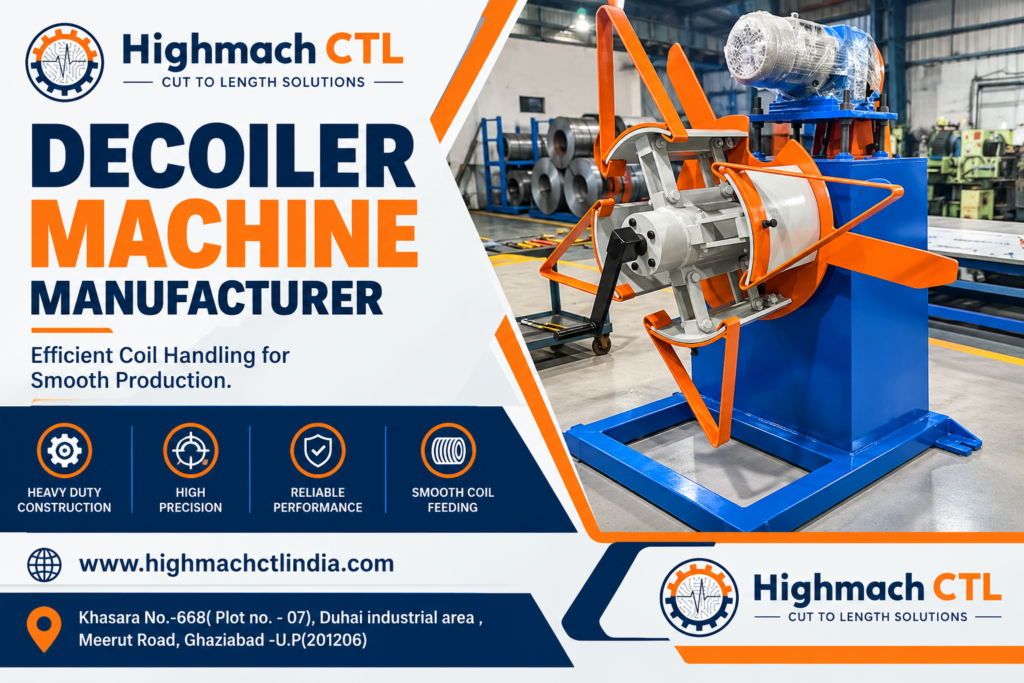
If your production line depends on a steady, controlled supply of coiled sheet or strip metal, the decoiler you choose has a direct impact on your output, safety, and downtime. A poorly matched or poorly built decoiler leads to uneven feeding, coil slippage, operator risk, and frequent line stoppages. Choosing the right decoiler machine — and the right Decoiler Machine Manufacturer — is one of the most practical decisions an industrial buyer can make when setting up or upgrading a coil-processing line.
This guide walks through what a decoiler machine is, how it works, the types available, what to look for when buying one, and how to evaluate a manufacturer before you commit to a purchase.
What is a Decoiler Machine?
A decoiler machine is a piece of coil-processing equipment designed to mount a metal coil onto a mandrel or cradle and rotate it so that the material unwinds smoothly. It is typically positioned at the start of a production line, ahead of straightening, leveling, feeding, or forming stations.
Decoilers are used wherever coiled material needs to be converted into flat sheet or strip form for further processing. Without a properly functioning decoiler, downstream equipment cannot receive material at a consistent rate, which affects part accuracy, cycle time, and overall line efficiency.
How Does a Decoiler Machine Work?
While designs vary by type and capacity, the general working principle of a decoiler machine follows a similar sequence:
- Coil loading – The coil is loaded onto the decoiler’s mandrel or cradle, either manually (for smaller coils) or using a crane, hoist, or coil car (for heavier coils).
- Coil securing and expansion – The mandrel expands mechanically or hydraulically to grip the inner diameter of the coil firmly, preventing it from shifting during rotation.
- Controlled unwinding – As the downstream line pulls material, the decoiler rotates, either freely, under motor drive, or with braking/tension control, depending on the machine type.
- Tension control – Many decoilers use braking systems, tension arms, or drive motors to maintain consistent strip tension, which prevents telescoping, overrun, or material sagging.
- Feeding to the next process – The unwound strip passes to a straightener, feeder, or leveler for further processing.
This sequence repeats until the coil is fully processed, at which point the machine is reloaded with a new coil.
Key Components of a Decoiler Machine
Most decoiler machines share a common set of core components, though construction details differ based on capacity and automation level:
- Mandrel or cradle assembly – Supports and centers the coil during rotation.
- Expansion mechanism – Mechanical or hydraulic system that grips the coil’s inner diameter.
- Drive motor – Powers rotation in motorized and automatic decoilers.
- Braking system – Controls unwinding speed and prevents coil overrun.
- Base frame and structure – Provides structural support and stability, especially important for heavier coils.
- Coil hold-down arm (on many models) – Prevents the coil from springing open during unwinding, particularly with high-tension or thin-gauge material.
- Control panel – On automatic and hydraulic models, allows operators to adjust speed, tension, and expansion.
Types of Decoiler Machines
Different production requirements call for different decoiler configurations. The main types include:
Manual Decoiler Machine
A manual decoiler machine is typically used for lighter coils and lower-volume operations. Coil loading, expansion, and braking may involve manual adjustment. These are cost-effective for smaller fabrication shops with lighter material requirements.
Hydraulic Decoiler Machine
A hydraulic decoiler machine uses hydraulic power for coil expansion and, in many cases, for lifting and loading. This type is well suited for heavier coils where manual expansion would be impractical or unsafe, and it’s commonly used in steel processing and sheet metal fabrication environments.
Automatic Decoiler Machine
An automatic decoiler machine integrates motorized rotation, tension control, and often coordinates directly with feeders and straighteners through a shared control system. These are used in higher-speed, higher-volume production lines where consistent, hands-off material feeding is essential.
Motorized Decoiler Machine
Motorized decoilers use a drive motor to actively rotate the coil rather than relying on the pull from downstream equipment alone. This helps maintain consistent tension and is especially useful for heavier or wider coils and higher-speed lines.
The right type depends on coil weight, material thickness, production speed, and the level of automation already present in your line.
| Decoiler Type | Best Suited For | Typical Coil Weight Range | Level of Automation |
| Manual Decoiler | Light-duty jobs, small fabrication shops | Light coils | Low |
| Hydraulic Decoiler | Heavier coils, frequent coil changes | Medium to heavy coils | Medium |
| Automatic Decoiler | High-speed, high-volume production lines | Medium to heavy coils | High |
| Motorized Decoiler | Wide or heavy coils needing active tension control | Medium to heavy coils | Medium to High |
Note: Exact capacity ranges vary by manufacturer and model; always confirm specifications against your actual coil parameters.
Key Features to Consider When Choosing a Decoiler Machine
Selecting a decoiler machine involves matching the equipment specifications to your actual production requirements. Important factors include:
- Coil weight capacity – The machine must safely handle your heaviest coils with margin, not just your average ones.
- Coil width – Should accommodate your full range of material widths without excessive adjustment.
- Coil inner diameter (ID) range – The expansion mechanism must fit the ID range of coils you typically process.
- Material thickness compatibility – Gauge range affects mandrel design, braking requirements, and hold-down needs.
- Expansion mechanism – Hydraulic expansion is generally preferred for heavier coils; mechanical expansion may suit lighter applications.
- Speed and control – Line speed requirements determine whether manual, motorized, or fully automatic control is appropriate.
- Machine construction – Frame rigidity and build quality affect long-term stability and accuracy, particularly under continuous operation.
- Safety features – Coil hold-downs, guarding, emergency stops, and interlocks are essential for operator protection.
- Automation and integration – Compatibility with existing feeders, straighteners, and press lines through shared controls or PLC integration.
- Customization requirements – Some operations need non-standard mandrel sizes, double-coil setups, or specific mounting configurations.
| Feature | Why It Matters |
| Coil weight capacity | Ensures the machine safely handles your heaviest coils, not just average ones |
| Coil width range | Confirms compatibility with your full range of material widths |
| Coil inner diameter (ID) | Determines whether the expansion mechanism fits your coil sizes |
| Material thickness | Affects mandrel design, braking, and hold-down requirements |
| Expansion mechanism | Hydraulic suits heavier coils; mechanical suits lighter loads |
| Speed and control | Matches decoiler output to your line’s production speed |
| Machine construction | Impacts long-term stability and dimensional accuracy |
| Safety features | Protects operators during loading, unwinding, and coil changeovers |
| Automation and integration | Determines compatibility with existing feeders and straighteners |
| Customization | Accommodates non-standard coil sizes or line configurations |
Benefits of Using a Quality Decoiler Machine
A well-engineered decoiler machine contributes to smoother, more reliable coil processing in several practical ways:
- Improved coil handling – Reduces manual lifting and repositioning, lowering the risk of operator injury.
- Smoother material feeding – Consistent tension control reduces material buckling, telescoping, or misfeeds.
- Reduced manual intervention – Automatic and motorized models minimize the need for constant operator adjustment.
- Better production consistency – Steady unwinding supports more uniform part quality in downstream forming or stamping.
- Improved operational efficiency – Fewer stoppages and faster changeovers help maintain production schedules.
These benefits compound over time, particularly in operations running multiple shifts or handling varied coil specifications.
Applications of Decoiler Machines
Decoiler machines are used across a wide range of manufacturing sectors, including:
- Steel processing – Slitting lines, cut-to-length lines, and blanking operations.
- Sheet metal fabrication – Feeding press lines and stamping operations.
- Automotive components – Supplying coil stock for body panels, brackets, and structural parts.
- Electrical equipment manufacturing – Processing coil for enclosures, panels, and housings.
- Construction products – Roll-formed profiles, roofing sheets, and structural sections.
- HVAC manufacturing – Ducting, panels, and sheet metal components.
- General engineering – Any operation that processes coiled sheet or strip material into finished or semi-finished parts.
How to Choose the Right Decoiler Machine Manufacturer
The manufacturer you choose matters as much as the machine specification itself. Here’s what to evaluate:
- Manufacturing experience – A manufacturer with hands-on experience across different coil weights, materials, and industries is better positioned to recommend the right configuration for your line.
- Machine construction and engineering – Look at frame design, material quality, and whether the manufacturer follows sound structural and mechanical engineering practices.
- Customization capability – Coil-processing needs vary; a manufacturer that can adapt mandrel size, capacity, or control features to your specific requirement adds real value.
- Quality control – Ask about inspection processes during fabrication, assembly, and pre-dispatch testing.
- Technical support – Availability of engineers who can guide specification selection, troubleshoot issues, and answer technical questions.
- Installation and commissioning – Whether the manufacturer supports on-site installation, alignment, and commissioning of the machine.
- Spare parts availability – Ready access to spares reduces downtime if a component needs replacement.
- After-sales service – Ongoing support for maintenance, repairs, and troubleshooting after installation.
- Machine compatibility with existing coil-processing lines – The decoiler should integrate smoothly with your current feeders, straighteners, and press equipment.
Taking time to evaluate these factors before purchase helps avoid costly mismatches between equipment capability and actual production needs.
| Evaluation Criteria | What to Check |
| Manufacturing experience | Track record across varied coil weights, materials, and industries |
| Machine construction | Frame design, build quality, and sound mechanical engineering |
| Customization capability | Ability to adapt mandrel size, capacity, or controls to your needs |
| Quality control | Inspection processes during fabrication, assembly, and pre-dispatch |
| Technical support | Access to engineers for specification guidance and troubleshooting |
| Installation and commissioning | On-site support for setup, alignment, and commissioning |
| Spare parts availability | Ready access to spares to minimize downtime |
| After-sales service | Ongoing maintenance, repair, and troubleshooting support |
| Line compatibility | Smooth integration with existing feeders, straighteners, and presses |
Why Consider Highmach CTL for Decoiler Machine Solutions?
Highmach CTL designs and manufactures coil-processing equipment, including decoiler machines, for industrial and sheet metal processing applications. As a manufacturer focused on coil handling equipment, Highmach CTL works with fabricators, processors, and manufacturers to specify machines suited to their coil weight, width, and production requirements.
Buyers evaluating decoiler options can discuss their specific coil parameters — weight, width, inner diameter, material type, and desired automation level — to identify a configuration that fits their production line.
Decoiler Machine: Maintenance and Safety Tips
Routine maintenance and correct operating practices extend equipment life and reduce the risk of downtime or injury:
- Regular inspection – Check the mandrel, expansion mechanism, and braking system periodically for wear or looseness.
- Lubrication – Follow the manufacturer’s lubrication schedule for bearings, gears, and moving components.
- Correct coil loading – Always load coils within the machine’s rated weight and width capacity, and center them properly on the mandrel.
- Machine alignment – Verify alignment between the decoiler and downstream equipment to prevent uneven feeding or strip wander.
- Electrical checks – Inspect wiring, control panels, and safety interlocks on motorized and automatic decoilers regularly.
- Safe operation practices – Keep hold-down arms engaged during unwinding, use proper lifting equipment for heavy coils, and ensure operators are trained on emergency stop procedures.
Consistent maintenance not only protects the equipment but also helps maintain the accuracy and safety of the entire coil-processing line.
Frequently Asked Questions
What is the difference between a decoiler and an uncoiler?
The terms are generally used interchangeably in the industry. Both refer to equipment that holds and unwinds a metal coil for processing.
What coil weight can a decoiler machine handle?
Capacity varies significantly by model, ranging from light-duty machines for coils under a ton to heavy-duty industrial decoilers rated for several tons. The right capacity depends on your specific coil specifications.
Do I need a hydraulic decoiler or a manual one?
Hydraulic decoilers are generally recommended for heavier coils or operations requiring frequent coil changes, since hydraulic expansion and lifting reduce manual effort and improve safety. Manual decoilers suit lighter, lower-volume applications.
Can a decoiler machine be integrated with a straightener and feeder?
Yes. Many decoilers, particularly automatic and motorized types, are designed to work as part of a coordinated straightener-feeder-decoiler (SFD) line, often with shared control systems.
What materials can a decoiler machine process?
Decoilers are commonly used with steel, stainless steel, aluminum, and other coiled sheet metals, provided the mandrel and capacity match the material’s weight and gauge.
How often should a decoiler machine be serviced?
Maintenance frequency depends on usage intensity, but routine inspection of the braking system, mandrel, and drive components is typically recommended on a scheduled basis, such as monthly or quarterly, alongside daily visual checks.
What safety features should a decoiler machine have?
Key safety features include coil hold-down arms, emergency stop controls, protective guarding around rotating parts, and interlocks that prevent operation during coil loading.
Conclusion
A decoiler machine plays a foundational role in any coil-processing line, directly affecting how smoothly material feeds into downstream operations. Choosing the right type — manual, hydraulic, automatic, or motorized — depends on your coil weight, width, material, and production speed requirements. Just as important is choosing a manufacturer with the engineering experience, quality control, and after-sales support needed to keep your line running reliably.
If you’re evaluating decoiler machine options for your production requirements, Highmach CTL can help you work through the specifications that matter for your operation. Reach out through highmachctlindia.com to discuss your coil-processing requirements.
Visit: https://highmachctlindia.com/
Call: +91-9811228235
Email: info@highmatchctl.com
Address: Khasara No.-668( Plot no. – 07), Duhai industrial area , Meerut Road, Ghaziabad -U.P(201206)