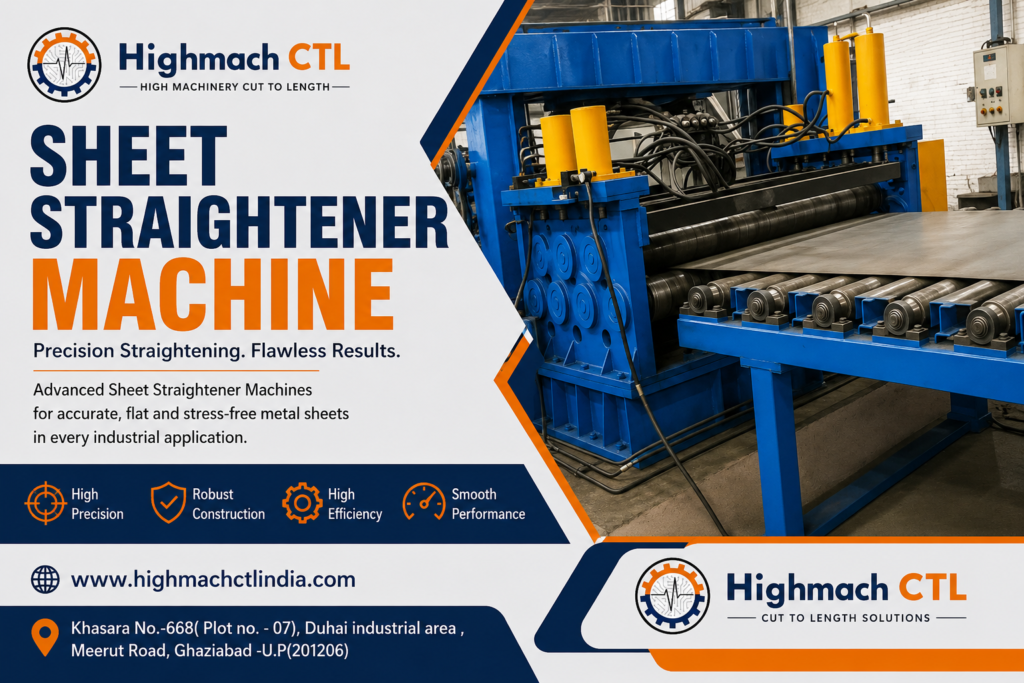
If you process metal coils, you already know what happens when sheets come off the coil with bends, curls or wave-like distortions. Downstream operations slow down, scrap rates climb, and dimensional accuracy suffers. This is the exact problem a Sheet Straightener Machine is built to solve.
Industrial buyers searching for this equipment are usually trying to answer one core question: which straightening machine will deliver consistently flat sheets across different material types, thicknesses and production volumes, without adding unnecessary cost or downtime. This guide walks through how the machine works, what to look for before buying, and how to avoid common selection mistakes.
A sheet straightener machine removes camber, curl and waviness from metal coils or sheets by passing them through a series of staggered rollers. This produces flat, dimensionally stable sheets ready for cutting, stamping, welding or fabrication, improving accuracy and reducing material waste in coil processing lines.
What Is a Sheet Straightener Machine?
A sheet straightener machine is a piece of metal-processing equipment that corrects flatness defects in coil-fed or pre-cut sheet metal. As coils are unwound, the material often retains internal stresses from rolling and winding, which show up as curl, camber, or edge waviness.
The straightener applies controlled bending forces through multiple rollers arranged in an offset pattern. This process realigns the internal stress in the metal, leaving the sheet flat and ready for further processing.
These machines are commonly used with hot rolled (HR), cold rolled (CR) and stainless steel (SS) coils across sheet metal fabrication, automotive component manufacturing, and general engineering industries.
How Does a Sheet Straightener Machine Work?
The working principle is mechanically straightforward but engineering-intensive to execute well.
- Material entry – The coil or sheet enters the machine through guide rollers that keep it centered.
- Roller bending action – The sheet passes through a set of upper and lower rollers positioned in a staggered arrangement. Each roller bends the material slightly in alternating directions.
- Progressive stress relief – As the sheet moves through successive rollers, the bending force gradually decreases, relieving internal stress without overworking the material.
- Flatness correction – By the time the sheet exits, camber, curl and wave defects are significantly reduced.
- Output to next process – The straightened sheet moves forward to cutting, shearing, blanking or coiling stations.
Roller gap and pressure settings are usually adjustable, allowing the same machine to handle different material thicknesses and grades.
Key Features and Components
Understanding the core components helps buyers evaluate machine quality more effectively.
Straightening Roller Assembly
The number of rollers (commonly ranging from 5 to 21+ depending on application) and their diameter determine how effectively the machine corrects different thickness ranges.
Roller Adjustment System
Manual or motorized adjustment mechanisms control the gap between rollers, allowing operators to fine-tune straightening pressure for different materials.
Frame and Housing
A rigid, precision-machined frame keeps rollers aligned under repeated load, which directly affects long-term straightening accuracy.
Drive System
Motors and gear systems control roller rotation speed, which needs to stay synchronized with the overall production line speed.
Entry and Exit Guides
These keep the sheet properly aligned as it enters and leaves the roller assembly, preventing edge damage or misfeeding.
Control Panel / PLC Integration
Modern straightener machines often include programmable controls for setting roller pressure, speed and thickness parameters, which supports repeatable results across shifts.
Benefits of a Sheet Straightener Machine
Improved dimensional accuracy – Flat sheets translate directly into more accurate cutting, punching and welding downstream.
Reduced material waste – Fewer rejected parts due to warping or misalignment means better material utilization.
Higher production efficiency – Straightened sheets move through downstream processes without manual correction, reducing cycle time.
Better weld and finish quality – Flat surfaces support cleaner welds and more consistent coating or painting results.
Support for automation – Straightener units integrate well into automated cut-to-length or slitting lines, reducing the need for manual handling.
Consistent output across batches – Adjustable roller settings allow the same machine to maintain quality across different coil batches and material grades.
Industrial Applications
Sheet straightener machines are used across a wide range of industries where flatness tolerance matters:
- Automotive component manufacturing – for body panels and structural parts requiring tight flatness tolerances
- Sheet metal fabrication – ahead of cutting, bending or stamping operations
- Appliance and white goods manufacturing – where surface finish and flatness affect final product appearance
- Construction and structural steel processing – for flat plate and profile production
- General engineering and job-shop metalworking – wherever coil-fed or pre-cut sheets need consistent flatness before further processing
Factors to Consider Before Buying a Sheet Straightener Machine
Choosing the right machine depends on matching specifications to your actual production needs, not just picking the highest roller count available.
Material type – HR, CR and stainless steel coils behave differently under bending force, so roller configuration should match the material grade you process most.
Thickness range – Confirm the machine’s rated minimum and maximum thickness covers your typical production range, with some margin for future jobs.
Coil/sheet width – Machine width should accommodate your widest regularly processed coil without frequent resetting.
Coil weight and line speed – Match the machine’s load capacity and processing speed to your production volume to avoid bottlenecks.
Straightening accuracy required – Applications like automotive panels need tighter flatness tolerance than general fabrication work.
Level of automation – Decide whether manual roller adjustment is sufficient or whether motorized/PLC-based control is worth the investment for repeatability.
Customization needs – Some production lines need integration with existing decoilers, levellers or cut-to-length lines, which affects machine footprint and layout.
Maintenance requirements – Ask about roller material, expected wear life, and ease of access for servicing.
After-sales support – Spare parts availability and technical support response time matter significantly over the machine’s operating life.
Common Buyer Mistakes to Avoid
Choosing based on price alone – A lower upfront cost can mean higher long-term costs from frequent roller replacement or inconsistent output.
Ignoring material variability – If you process multiple material types or thickness ranges, buying a machine sized only for your current job can limit future flexibility.
Overlooking line integration – A straightener that doesn’t align well with existing decoiler or cutting line speed can create bottlenecks instead of solving them.
Underestimating roller wear – Skipping questions about roller material and wear life often leads to unexpected downtime later.
Not requesting a trial run or sample test – Buyers who skip this step sometimes discover flatness tolerance issues only after installation.
Why Choose the Right Manufacturer?
The performance of a sheet straightener machine depends heavily on engineering precision — roller alignment, frame rigidity and drive synchronization all affect real-world flatness results, not just published specifications.
A manufacturer that offers pre-dispatch testing, application-specific customization, and proper installation support reduces the risk of performance gaps between what’s promised and what’s delivered on the shop floor. After-sales service — including spare parts availability and technical response time — also plays a direct role in machine uptime over its operating life.
Highmach CTL designs and manufactures sheet straightener machines alongside a broader range of coil processing equipment, including cut-to-length lines, slitting lines and sheet levellers, which allows for configurations built around how a specific production line actually operates rather than a one-size-fits-all setup.
FAQs
1. What is the difference between a sheet straightener and a sheet leveller?
Both correct flatness defects, but levellers typically use a higher number of smaller-diameter rollers for finer flatness tolerance, while straighteners are often used for general camber and curl correction ahead of leveling or cutting.
2. Can one machine handle both HR and CR coils?
Some machines are built for multi-material use with adjustable roller pressure, but performance depends on the roller configuration. It’s best to confirm the rated material range with the manufacturer before buying.
3. How often do straightening rollers need replacement?
This depends on material hardness, production volume and roller material quality. Manufacturers can typically provide expected wear life based on your specific application.
4. Does a sheet straightener machine slow down production speed?
When correctly sized for your coil width and line speed, a straightener integrates into the process without becoming a bottleneck. Undersized machines are the more common cause of slowdowns.
5. Can the machine be integrated into an existing coil processing line?
Yes, in most cases. Integration depends on matching line speed, footprint and control system compatibility with existing decoilers, levellers or cut-to-length equipment.
Conclusion
A sheet straightener machine plays a foundational role in coil processing accuracy — poor flatness at this stage carries through every downstream operation, from cutting to welding to final assembly. Choosing the right machine means matching roller configuration, thickness range, and automation level to your actual production needs, not just comparing specification sheets.
Visit: https://highmachctlindia.com/
Call: +91-9811228235
Email: info@highmatchctl.com
Address: Khasara No.-668( Plot no. – 07), Duhai industrial area , Meerut Road, Ghaziabad -U.P(201206)