Picture this: your production line is humming along, orders are piling up, and every sheet of metal coil still needs to be measured, marked, and cut by hand. One small slip and you’ve got a scrapped sheet, a frustrated operator, and a client waiting on a delivery that’s now running late. If this sounds familiar, you’re not alone — it’s one of the most common headaches in metal processing shops that haven’t yet made the switch to automation.
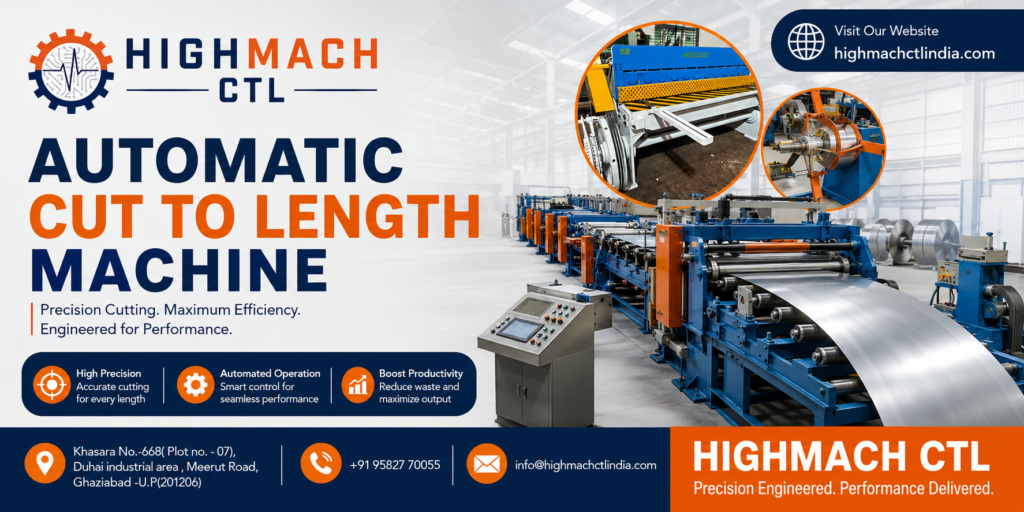
This is exactly where an Automatic Cut to Length Machine earns its keep. It takes the guesswork, the fatigue, and the human error out of cutting coiled metal into precise, consistent lengths — sheet after sheet, shift after shift. Whether you’re running a steel service center, a roofing sheet business, or an appliance manufacturing unit, understanding how these machines work — and how to choose the right one — can save you real money and real headaches down the line.
In this guide, we’ll walk through everything you need to know before investing in a cut to length (CTL) line: how it works, what to look for, common mistakes buyers make, and answers to the questions we hear most often at Highmach CTL.
What is an Automatic Cut to Length Machine?
An automatic cut to length machine is an industrial system designed to uncoil metal (usually steel, stainless steel, or aluminum), straighten it, and cut it into precise, pre-set lengths — all automatically, with minimal operator intervention. Think of it as a highly disciplined assembly line worker who never gets tired, never miscounts, and never cuts a sheet a few millimeters short.
These machines are widely used in industries like automotive manufacturing, construction, appliance production, and general sheet metal fabrication, where consistency and speed matter just as much as accuracy.
How Does It Actually Work?
At a basic level, a cut to length line typically includes these core components working together:
- Decoiler – holds and unwinds the metal coil
- Straightener – removes coil-set curvature so the sheet lies flat
- Feeding unit – pulls the metal through at a controlled speed
- Measuring system – tracks length using encoders or sensors
- Shearing/cutting unit – cuts the sheet at the programmed length
- Stacking table – collects and organizes finished sheets
The entire process is controlled through a PLC (programmable logic controller) or an industrial computer, where the operator simply enters the desired length, thickness, and quantity — the machine handles the rest.
Why Businesses Are Switching to Automatic CTL Lines
Manual cutting isn’t just slower — it’s inconsistent. A skilled worker might cut accurately for the first fifty sheets of a shift, but fatigue, distraction, or worn-out measuring tools eventually creep in. Automatic systems remove that variability entirely, which is why so many manufacturers are upgrading.
Key Benefits at a Glance
- Precision cutting — tolerances as tight as ±0.1mm depending on the machine
- Higher throughput — cut hundreds of sheets per hour instead of dozens
- Reduced material waste — accurate measuring means fewer scrapped sheets
- Lower labor dependency — one operator can run what used to take a full team
- Consistent quality — every sheet matches specification, every time
- Better safety — automated guarding reduces manual handling risks
Feature vs. Benefit: Why It Matters
| Feature | Why It Matters |
| Servo-driven feeding | Delivers repeatable accuracy without manual adjustment between runs |
| PLC-based controls | Lets operators store and recall cutting programs for different jobs instantly |
| Hydraulic or rotary shear | Determines cut quality, edge finish, and suitability for material thickness |
| Automatic stacking | Reduces manual handling time and keeps finished sheets organized |
| Non-marking rollers | Protects surface finish, especially important for pre-painted or coated coils |
Table note: Not every job needs every feature — match the feature set to your material type and production volume.
Types of Cut to Length Machines: A Comparison
Not all CTL lines are built the same. The right choice depends on your material thickness, coil width, and how much volume you’re running daily.
Comparison Table: Standard vs Heavy-Duty vs High-Speed CTL Lines
| Type | Best For | Typical Thickness | Speed Range |
| Standard CTL | Light-gauge sheet, general fabrication | 0.3mm – 3mm | Moderate |
| Heavy-Duty CTL | Thicker steel, structural components | 3mm – 12mm+ | Slower, higher force |
| High-Speed CTL | High-volume production lines | 0.3mm – 2mm | Very fast |
Table note: Thickness and speed figures vary by manufacturer and model — always confirm specs against your actual material grade.
Step-by-Step: How to Choose the Right Machine
Buying a CTL line isn’t a decision to rush. Here’s a simple, practical process to follow.
Buying Process Table
| Step | What To Do |
| 1. Assess your material | Note the coil width, thickness range, and material type you’ll be processing most |
| 2. Calculate your volume | Estimate daily/monthly cutting volume to size the machine correctly |
| 3. Define accuracy needs | Decide the tolerance level your end product requires |
| 4. Compare vendors | Request specs, warranty terms, and after-sales support details |
| 5. Check floor space & power | Confirm your facility can support the machine’s footprint and electrical load |
| 6. Plan installation & training | Confirm the supplier provides setup support and operator training |
Table note: Skipping any of these steps is one of the most common reasons buyers end up with an undersized or oversized machine.
Tips & Best Practices
- Always factor in future growth — buy slightly ahead of your current needs, not just for today’s orders.
- Prioritize after-sales service — a great machine with poor support becomes a liability during downtime.
- Ask for a live demo — seeing the machine cut your actual material tells you more than any spec sheet.
- Maintain your straightener rollers — worn rollers are a silent cause of poor flatness and inaccurate cuts.
- Train more than one operator — don’t let your entire line depend on a single person’s know-how.
Common Mistakes to Avoid
Do’s and Don’ts Table
| Do | Don’t |
| Match the machine to your actual coil specs | Buy based only on price without checking capacity |
| Ask about spare parts availability upfront | Assume all suppliers offer the same warranty terms |
| Schedule regular preventive maintenance | Wait for a breakdown to think about servicing |
| Involve your operators in the selection process | Leave training as an afterthought post-installation |
Table note: Most costly mistakes with CTL machines happen before the machine is even installed — during the buying stage.
Frequently Asked Questions
1. What materials can an automatic cut to length machine process?
Most CTL lines handle carbon steel, stainless steel, galvanized steel, and aluminum coils, with thickness ranges depending on the machine’s shear capacity.
2. How accurate is an automatic cut to length machine?
Well-maintained, servo-driven CTL lines typically achieve tolerances between ±0.1mm and ±0.5mm, depending on material thickness and machine quality.
3. Is an automatic CTL machine suitable for small businesses?
Yes — many manufacturers, including Highmach CTL, offer compact and mid-range models designed for smaller production volumes without the cost of a full industrial-scale line.
4. How much floor space does a cut to length line need?
This varies by model, but a typical line — including decoiler, straightener, shear, and stacking table — can range from 15 to 40 meters in length, depending on coil size and capacity.
5. What’s the difference between a cut to length line and a slitting line?
A cut to length machine cuts coils into individual flat sheets of a set length, while a slitting line cuts coils lengthwise into narrower coils. Some facilities use both, depending on their product range.
6. How long does installation typically take?
Installation timelines depend on machine size and facility readiness, but most standard CTL lines can be installed and commissioned within a few weeks with proper planning and vendor support.
Final Thoughts
An automatic cut to length machine isn’t just another piece of factory equipment — it’s often the difference between a production line that struggles to keep up with demand and one that runs smoothly, accurately, and profitably. The right machine reduces waste, protects your margins, and frees up your team to focus on growing the business instead of babysitting manual cuts.
Choosing the right CTL line comes down to understanding your material, your volume, and your long-term goals — not just picking the cheapest option on a spec sheet. Take your time, ask the right questions, and work with a supplier who understands your specific production needs.
At Highmach CTL, we’ve spent years helping manufacturers find the right cut to length solution for their exact requirements. If you’re weighing your options or just starting to explore automation for your cutting process, we’re happy to walk you through what makes sense for your operation — no pressure, just honest guidance.
Visit: https://highmachctlindia.com/
Call: +91-9811228235
Email: info@highmatchctl.com
Address: Khasara No.-668( Plot no. – 07), Duhai industrial area , Meerut Road, Ghaziabad -U.P(201206)