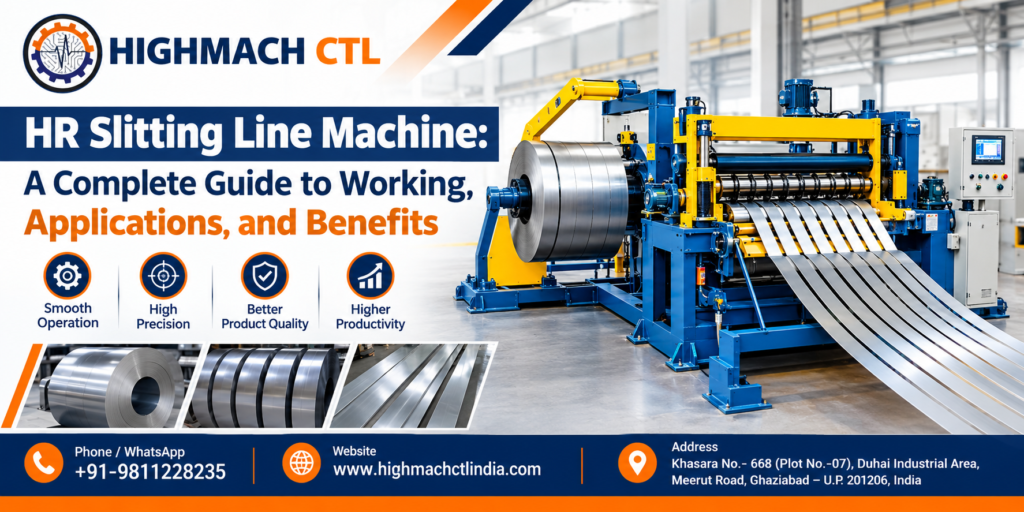
Hot-rolled steel coils usually arrive at processing units in wide, heavy formats. Most manufacturers need narrower strips, in specific widths, to feed their own production. An HR Slitting Line Machine bridges that gap by converting wide hot-rolled coils into multiple narrower strips in a controlled, repeatable process.
This guide covers how the machine works, its main components, where it is used, the benefits it offers, and what to consider before buying one.
What Is an HR Slitting Line Machine?
An HR Slitting Line Machine is industrial equipment that cuts a wide hot-rolled (HR) steel coil lengthwise into several narrower coils. Hot-rolled steel is produced by rolling steel at high temperature, and it is widely used in construction, fabrication, and general engineering.
Slitting is different from cut-to-length processing. A cut-to-length line cuts the strip across its width to produce flat sheets. A slitting line cuts along the length of the strip and recoils the result into narrower coils.
Consistent slit width matters because strips that vary in width can cause problems in downstream forming, welding, or fabrication. A suitable machine configuration helps keep strip dimensions and edge quality within the buyer’s requirements.
How Does an HR Slitting Line Machine Work?
The exact sequence depends on the line design and customer requirements, but a typical process looks like this:
- Coil loading: The hot-rolled coil is placed on the line using suitable handling equipment, such as a crane or coil car.
- Uncoiling: The uncoiler unwinds the coil and feeds the strip into the line.
- Leveling or straightening: Where included in the configuration, the strip is straightened to meet process requirements.
- Slitting: Circular slitting blades cut the wide strip into narrower strips.
- Tension control and guiding: Separators and tensioning systems keep the slit strips aligned and moving steadily.
- Recoiling: The narrow strips are wound into finished coils.
- Inspection and handling: Operators check dimensions, edge condition, and coil quality before the coils are removed and moved on.
Main Components of an HR Slitting Line Machine
Each component plays a specific role in keeping the line stable and productive:
- Coil loading and handling equipment: Moves heavy coils safely onto the line.
- Uncoiler: Holds the coil and releases the strip in a controlled way.
- Entry guides and pinch rolls: Align the strip and help feed it into the slitting section.
- Leveler or straightening unit (if provided): Improves strip flatness before slitting.
- Slitting head and circular blades: Perform the actual cutting. Blade setup influences slit quality.
- Separators and tensioning equipment: Keep the cut strips apart and under suitable tension for clean recoiling.
- Recoiler: Winds the finished strips into coils.
- Electrical controls and safety systems: Support operation, monitoring, and safer working practices.
When these units are properly matched, they support consistent steel strip processing from the first coil to the last.
Applications of an HR Slitting Line Machine
Narrow hot-rolled strips are useful across many industries. Typical users include:
- Steel service centres and coil processing units
- Sheet metal fabrication shops
- Structural and general engineering companies
- Manufacturers that need narrower hot-rolled strips for their own products
- Automotive component supply chains, where material specifications are suitable
Suitability always depends on the steel grade, thickness, coil width, edge-quality expectations, and the downstream application.
Key Benefits of Using an HR Slitting Line Machine
A well-matched line can offer several practical advantages:
- Efficient processing of wide coils: One coil can be converted into several narrower strips in a single operation.
- Better slit-width control: When properly configured and maintained, the line supports more consistent strip widths.
- Repeatable workflows: Standardised setups help production teams run similar jobs reliably.
- Reduced manual handling: Appropriately automated systems can limit the need for manual material movement.
- Improved material planning: Processing in-house lets manufacturers order wider coils and slit them to the sizes they need.
- Potential productivity gains: These are possible when the machine matches the production workload.
Actual performance depends on equipment configuration, material properties, operator skill, maintenance, and production conditions.
Important Factors to Consider Before Buying
Before finalising a machine, review the following:
- Material specifications: Steel grades, thickness range, coil width, and coil weight.
- Slitting requirements: Required strip widths, number of strips, and edge-quality expectations.
- Production capacity: Expected throughput, operating schedule, and workload.
- Line configuration: Uncoiler capacity, slitting head arrangement, tension control, and recoiling needs.
- Automation and controls: Ease of operation and integration with existing processes.
- Safety and maintenance: Guarding, operating procedures, and access for servicing.
- Space and installation: Factory layout, foundation requirements, material flow, and handling equipment.
- Supplier support: Installation, commissioning, operator training, spare parts, and after-sales service.
Share your actual production requirements with the supplier before the specification is finalised. This helps avoid mismatches between the machine and the job.
HR Slitting Line Machine: Important Selection Parameters
Use the table below as general buyer guidance. Confirm the actual values for any machine directly with the manufacturer.
| Selection parameter | Why it matters |
| Material thickness | Determines whether the line can process the required steel thickness |
| Maximum coil width | Establishes the incoming coil size the line can accommodate |
| Maximum coil weight | Helps determine uncoiler and material-handling requirements |
| Slit-width range | Indicates whether the line can produce the required strip dimensions |
| Slitting speed | Affects production planning and throughput |
| Blade configuration | Influences slit quality and the range of cutting setups |
| Recoiler capacity | Helps determine finished-coil handling capability |
| Automation and safety | Supports operational control and safer working practices |
These parameters should be matched to your own material range and production targets, not chosen in isolation.
Why Consider HighMach CTL?
HighMach CTL is a company that buyers can contact to discuss their hot-rolled steel coil slitting requirements. You can learn more about the slitting line for HR (hot-rolled) steel on the company’s product page.
Prospective buyers can enquire about machine configuration, technical suitability, production needs, installation requirements, and available support. Discussing your material range and output goals early helps ensure the recommended setup fits your operation.
Frequently Asked Questions (FAQs)
1. What does an HR Slitting Line Machine do?
It cuts wide hot-rolled steel coils lengthwise into several narrower strips and recoils them. This lets manufacturers and service centres obtain strip widths suited to their downstream fabrication or production needs.
2. What is the difference between slitting and cut-to-length?
Slitting cuts a coil along its length to produce narrower coils. Cut-to-length lines cut across the strip’s width to produce flat sheets or blanks. The two processes serve different product requirements, and some processors use both.
3. Can one machine handle all thicknesses and widths of hot-rolled steel?
Not necessarily. Every line is designed for a specific range of thickness, coil width, and coil weight. Buyers should confirm that the machine’s capability covers their full material range before purchase.
4. What affects slit-width accuracy?
Several factors influence it, including blade setup and condition, strip tension, machine alignment, material properties, and operator practice. Regular maintenance and correct setup procedures help keep slit widths consistent over time.
5. What should I share with a supplier when requesting a quote?
Provide your steel grades, thickness and coil width range, coil weight, required strip widths, expected output, and available floor space. This information helps the supplier recommend a suitable configuration.
Conclusion
An appropriately configured HR Slitting Line Machine helps convert wide hot-rolled coils into narrower strips for many manufacturing needs. The best results come from matching the machine to your material dimensions, slit-width requirements, production volume, and factory conditions.
If you are evaluating equipment, contact HighMach CTL to discuss your hot-rolled steel coil slitting requirements and explore a suitable machine configuration.
Contact Information
HighMach CTL
- Phone / WhatsApp: +91-9811228235
- Website: https://www.highmachctlindia.com/
- Address: Khasara No.- 668 (Plot No.-07), Duhai Industrial Area, Meerut Road, Ghaziabad – U.P. 201206, India