
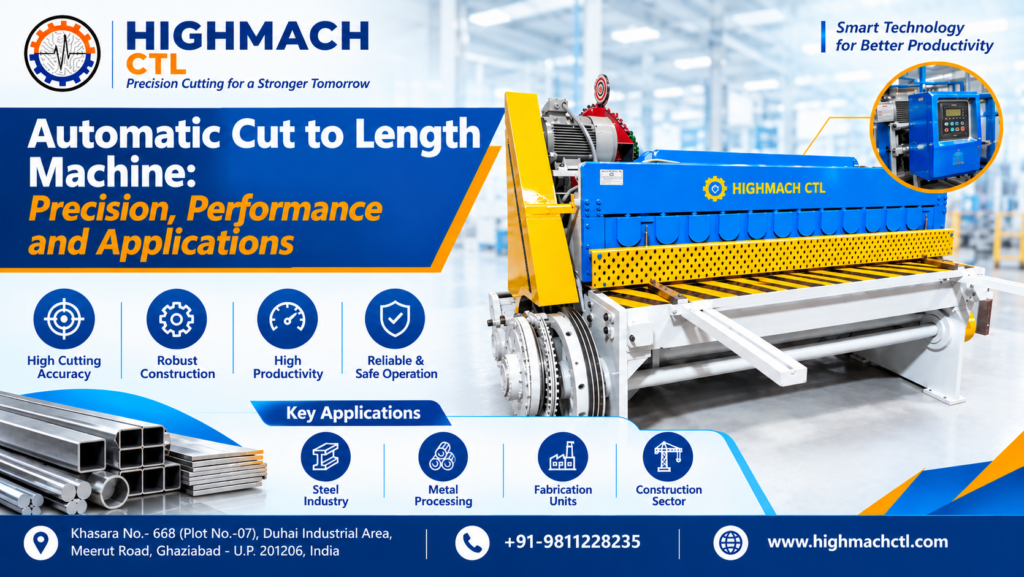
A production manager at a sheet-metal plant receives a heavy coil of steel in the morning. By the afternoon, the shop floor needs hundreds of flat blanks in exactly the same size. If the coil is uncoiled, straightened, measured and cut by hand, every step becomes a chance for variation: a slightly different length here, a handling delay there, and an operator tied up on a repetitive task.
Manual or partly automated cutting often brings inconsistent measurements, heavy manual handling, production interruptions, avoidable material wastage and difficulty keeping output uniform in high-volume runs. An Automatic Cut to Length Machine addresses these problems by combining coil handling, leveling, feeding and cutting in one coordinated line.
What Is an Automatic Cut to Length Machine?
An Automatic Cut to Length Machine, often called an automatic CTL machine, converts continuous metal coil into flat blanks of the required size. Instead of treating each task separately, it links several operations in sequence:
- Coil loading
- Decoiling
- Leveling
- Servo-controlled feeding
- Measurement and positioning
- Precision cutting
- Blank handling
- Stacking or conveying
The exact configuration depends on the material, thickness, coil dimensions, production volume and the finished blank requirements. Highmach CTL’s Auto Blanking Line follows this coil-to-sheet logic, with a process flow that runs from the coil car and hydraulic un-coiler through leveling and servo feeding to the cutting stage.
How Does an Automatic Cut to Length Machine Work?
Step 1 – Coil Loading
The coil is placed on a loading platform or carried by a coil car and positioned in front of the decoiler. Good loading keeps material handling organized and safe before processing begins.
Step 2 – Decoiling
The decoiler (un-coiler) holds the coil and unwinds it steadily. A guide plate then directs the strip into the line, giving a continuous flow of material.
Step 3 – Leveling
Coiled metal naturally keeps a curve, known as coil set, along with internal stresses. A leveling unit passes the strip through a series of rollers to reduce that curvature and produce flatter material. Flatness matters because it directly affects how accurately the material can be measured, cut and used downstream.
Step 4 – Servo Feeding
A servo feeder moves the material forward by controlled amounts. Because the movement is programmed, it helps keep positioning consistent from one blank to the next.
Step 5 – Precision Cutting
Once the strip reaches the set length or position, the cutting unit separates the blank. Highmach CTL’s referenced blanking line uses a power press and a scrap-cutting shear in its flow.
Step 6 – Stacking and Material Handling
Finished blanks can be stacked or conveyed for the next operation, which reduces manual picking and sorting.
Step 7 – Scrap Management
Cutting produces offcuts and scrap. Handling them in an organized way keeps the work area cleaner and the line running smoothly.
Every line is configured around the production requirement, so the stages above can vary from one installation to another.
Table 1: Automatic Cut to Length Machine – Process Overview
| Process Stage | Main Function | Production Benefit |
| Coil Loading | Positions the incoming coil on the line | Supports organized, safer material handling |
| Decoiling | Unwinds the metal coil under control | Provides continuous material flow |
| Leveling | Reduces coil set and improves flatness | Prepares material for accurate measuring and cutting |
| Servo Feeding | Moves the strip by programmed lengths | Supports consistent positioning blank to blank |
| Precision Cutting | Cuts material to the specified dimensions | Produces uniform blanks for later processes |
| Stacking/Conveying | Collects or moves finished blanks | Reduces manual handling and sorting |
| Scrap Handling | Removes cutting waste from the work area | Supports a cleaner, uninterrupted workflow |
Key Features of an Automatic Blanking Line
High-Speed Automatic Blanking
Automation lets the line run continuously with less operator intervention. Actual output depends on the material, blank size and line configuration, so speed should always be confirmed with the manufacturer for your application.
Precision Cutting
Blanks that match their specified size reduce fit-up problems and rework in forming, stamping or assembly. Dimensional consistency is one of the main reasons manufacturers move to automatic cutting.
Servo Feeding System
Servo control coordinates how far and how fast the material moves, which supports repeatable lengths across a production run.
Integrated Leveling Unit
A built-in leveler means material is flattened before it is cut, rather than needing a separate correction step afterward.
PLC-Based Automation
A PLC coordinates the machine functions and lets operators monitor the process and adjust parameters such as blank length and quantity for different jobs.
Materials Suitable for Automatic Cut to Length Processing
Highmach CTL’s blanking line is associated with common coil materials, including:
- Hot Rolled (HR) steel
- Cold Rolled (CR) steel
- Stainless steel
Its website and product listings also refer to applications involving aluminum and mild steel. Material compatibility is not universal, though. It depends on the machine design, thickness range and the processing requirement, so each material and grade should be confirmed against the specific configuration.
Applications of Automatic Cut to Length Machines
Automotive Manufacturing
Automotive suppliers need accurately sized blanks that feed into forming, stamping and assembly. The machine prepares the blanks; those later operations happen elsewhere.
Appliance Manufacturing
Consistent sheet blanks help appliance makers prepare material for housings, panels and related components.
Electrical Panel Manufacturing
Enclosures and panels depend on accurately prepared sheet, since dimensional errors carry into folding, punching and assembly.
Sheet Metal Fabrication
Fabricators with repetitive jobs benefit from repeatable dimensions and efficient material handling.
General Industrial Manufacturing
Automated coil-to-sheet processing suits plants that run larger volumes and want a steady flow of blanks to downstream work.
Table 2: Industry Applications and Production Requirements
| Industry | Typical Requirement | How Automatic Blanking Helps |
| Automotive | Consistent metal blanks | Supplies repeatable blanks for subsequent forming |
| Appliances | Uniform sheet sizes | Improves material preparation for later processes |
| Electrical Panels | Accurate sheet dimensions | Supports enclosure fabrication with well-prepared sheet |
| Sheet Metal Fabrication | Flexible cutting requirements | Helps streamline repetitive cutting jobs |
| Industrial Manufacturing | High-volume processing | Supports continuous, automated blank production |
Benefits of Using an Automatic Cut to Length Machine
1. Consistent cutting. Automated measurement and feeding support repeatable blank dimensions.
2. Improved production efficiency. Combining feeding, cutting and handling removes many repetitive manual steps.
3. Reduced material wastage. Accurate cutting and an organized workflow can improve material utilization. The saving varies by operation, so avoid relying on any fixed percentage.
4. Better material handling. Integrated loading, decoiling, leveling, cutting and stacking create a smoother flow from coil to blank.
5. Reduced manual intervention. Operators spend less time on repetitive tasks, though trained personnel are still needed for setup, supervision and maintenance.
6. Consistent output. Uniform blanks matter most during continuous production, where small variations add up.
7. Support for high-volume production. Repeatable processing is most valuable across larger runs.
Automatic Cut to Length Machine vs. Manual Cutting
| Aspect | Manual / Less-Automated Cutting | Automatic CTL Line |
| Material handling | Frequent manual lifting and positioning | Coil handling and stacking integrated into the line |
| Measurement | Operator-dependent | Controlled by feeder and PLC settings |
| Repeatability | Varies with operator and fatigue | Programmed, repeatable lengths |
| Operator involvement | High and repetitive | Focused on setup and supervision |
| Workflow | Stop-start between stages | Continuous, linked stages |
| Scalability | Limited by labor | Better suited to growing volumes |
Automation does not remove every error. Results still depend on correct setup, regular maintenance, material characteristics and sensible operating parameters.
Factors to Consider Before Choosing an Automatic Cut to Length Machine
A good selection starts with accurate data. Before approaching a manufacturer, work out your material type and thickness, coil width and weight, required blank dimensions, production volume and target line speed. Then consider the level of automation, leveling needs, feeding accuracy, cutting method and stacking arrangement. Finally, check factory space, power and installation requirements, maintenance and service support, and any future production needs. Sharing precise details up front helps the manufacturer recommend a suitable configuration.
Table 3: Automatic Cut to Length Machine – Buying Checklist
| Selection Factor | Questions to Ask | Why It Matters |
| Material | What metals and grades will be processed? | Determines machine compatibility |
| Thickness | What are the minimum and maximum thicknesses? | Influences machine and cutting capacity |
| Coil Width | What coil widths are commonly used? | Helps determine line configuration |
| Coil Weight | What is the maximum coil weight? | Important for loading and decoiling |
| Blank Size | What lengths and widths are required? | Determines cutting and feeding requirements |
| Production Volume | How much material is processed per shift or month? | Helps determine automation level and capacity |
| Stacking | How should finished blanks be collected? | Influences downstream handling |
| Service | What installation and after-sales support is needed? | Important for long-term operation |
Why Automation Matters in Modern Coil Processing
Automation in coil processing is mostly practical rather than futuristic. Coordinated stages keep the workflow moving, and reduced manual handling frees people for supervision. Servo feeding keeps material movement consistent, while PLC controls make it easier to monitor the process and switch between production jobs. Together they improve repeatability and make it simpler to adjust a line when blank sizes change.
Why Consider Highmach CTL?
Highmach CTL, based in Ghaziabad, describes itself as a manufacturer of cut to length machines, slitting lines, auto blanking lines, shearing machines, zig-zag circle cutting lines and related sheet-processing equipment. Its Auto Blanking Line brings together automated feeding and leveling, servo-controlled feeding, PLC-based automation, coil handling and stacking for HR, CR and stainless steel coils. These lines serve automotive, appliance, electrical panel and sheet-metal applications, and the company says it can customize lines to customer requirements, supported by after-sales service.
For manufacturers comparing options, the useful step is a direct conversation about your own material and production details.
Frequently Asked Questions
1. What is an Automatic Cut to Length Machine used for?
It converts metal coil into flat blanks of specified size for later forming, fabrication or assembly.
2. Is a cut to length line the same as an auto blanking line?
They overlap. Both turn coil into sheets or blanks. An auto blanking line is typically configured for blank production, often with a press, while the exact setup varies by supplier.
3. Which materials can be processed?
Common materials include HR, CR and stainless steel, and aluminum and mild steel in suitable configurations. Compatibility depends on thickness range and machine design.
4. Why is leveling important before cutting?
Coil set and internal stress leave material curved. Leveling flattens it so measuring, cutting and downstream operations are more accurate.
5. What details should I share with a manufacturer?
Material type and grade, thickness, coil width and weight, blank dimensions, production volume and automation needs.
Talk to Highmach CTL About Your Requirement
If you are evaluating an automatic cut-to-length or auto blanking solution, contact Highmach CTL with your material type, thickness, coil width, coil weight, required blank dimensions, production volume and automation requirements. The team can then discuss a configuration that fits your production.
E-mail: info@highmatchctl.com
Phone / WhatsApp: +91-9811228235
Address: Khasara No.- 668 (Plot No.-07), Duhai Industrial Area, Meerut Road, Ghaziabad – U.P. 201206, India