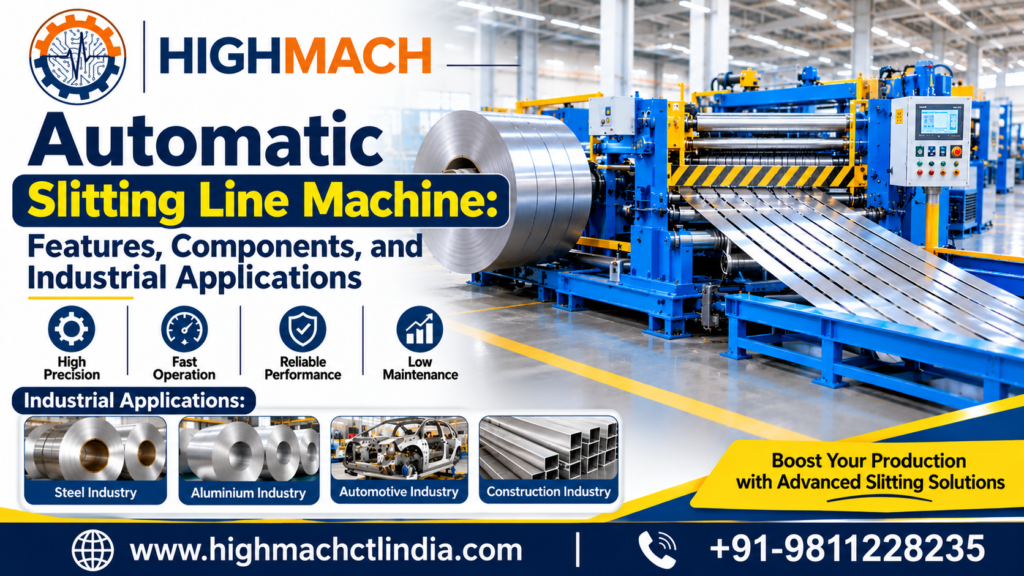
Metal rarely arrives at a factory in the width it will finally be used. Steel and other metals are produced as wide coils, while the parts, profiles and components made from them need narrower, precisely sized strips. An automatic slitting line machine bridges that gap by cutting wide coils into narrower strips in a controlled, repeatable way.
For metal processors, fabricators and service centres, this step shapes everything that follows. Strip width affects how material is stamped, formed, rolled or welded, and consistent widths mean fewer problems downstream. Automation adds to this by reducing manual handling and helping keep the process steady from coil to coil.
This guide explains what an automatic slitting line machine is, its key features and components, how it works, where it is used and what buyers should consider before choosing one.
What Is an Automatic Slitting Line Machine?
A slitting line is a group of machines working together to unwind a wide metal coil, cut it lengthwise into several narrower strips and wind those strips back into coils. The cutting is done by circular blades that run along the moving material.
The word automatic points to how much of the process is controlled by the machine rather than by hand. Coil handling, feeding, tension and winding are managed through the line’s mechanical and control systems, which helps with precision coil processing and steadier production.
An industrial slitting line like this is not a single machine but a sequence of stations. Each handles one part of the job, from holding the coil to collecting the finished strips.
Key Features of an Automatic Slitting Line Machine
Features vary between manufacturers and models, so these are general characteristics buyers can look for rather than a statement about any one machine:
- Automated coil feeding and processing: The coil is fed through the line in a controlled way.
- Precision slitting: Circular blades cut the coil into strips along set lines.
- Adjustable slitting configurations: Blade positions can be set to produce different strip widths.
- Consistent strip-width control: Well-set tooling helps keep widths even along the length of the coil.
- Production efficiency and reduced manual handling: Mechanised handling lowers the effort of moving heavy coils.
- Safety and operational controls: Guarding and control panels help operators run the line safely.
The exact capabilities, including speed, thickness range and coil capacity, are set by the specific machine and should be confirmed with the manufacturer.
Major Components of an Automatic Slitting Line
A typical slitting line is built from the following sections. Actual layouts differ by manufacturer and model.
- Decoiler or uncoiler: Holds the coil and releases it into the line.
- Coil loading and feeding system: Brings the coil to the decoiler and guides the strip start.
- Pinch rolls and leveller: Guide the strip forward and help flatten it before cutting.
- Slitting head with circular blades: Cuts the coil into narrower strips.
- Scrap winder: Collects the edge trim removed during slitting.
- Tension control system: Keeps the strip under steady tension during winding.
- Recoiler: Winds the slit strips back into coils.
- Electrical and control system: Coordinates the stations and lets operators set and monitor the process.
The summary table below shows how the main sections relate.
| Component / System | Main Function | Role in Slitting |
| Decoiler | Holds and releases the metal coil | Feeds material into the line |
| Pinch Rolls | Guides and feeds the strip | Supports smooth material movement |
| Slitting Head | Uses circular blades to cut the coil | Produces narrower metal strips |
| Scrap Winder | Collects edge-trim scrap | Manages scrap material |
| Tension System | Controls strip tension | Supports stable processing |
| Recoiler | Winds the slit strips | Collects finished strips into coils |
These are typical components of slitting lines in general. Which ones a particular machine includes should be confirmed with the manufacturer.
How Does an Automatic Slitting Line Machine Work?
The general process runs in order:
- Coil loading: A wide coil is lifted onto the decoiler and secured.
- Feeding: The strip end is threaded through the line, guided by pinch rolls and, where fitted, a leveller.
- Slitting: The moving strip passes through the slitting head, where circular blades cut it lengthwise into the required widths. Edge trim is separated at the same time.
- Scrap handling: Trimmed edges are collected on a scrap winder.
- Tension control: The slit strips pass through a tension system so they wind evenly.
- Recoiling: The narrow strips are wound onto a recoiler to form finished coils.
- Unloading: The finished coils are removed for packing or the next process.
At every step, set-up matters. Blade spacing, clearance and tension all influence strip width and edge quality, so careful set-up and regular blade maintenance are part of good practice.
Industrial Applications of Slitting Line Machines
Wherever a project needs metal strips of an exact width, slitting is likely to come first.
- Automotive and auto-component manufacturing: Stamped and formed parts often start as strips cut to a specific width.
- Construction and infrastructure: Strips feed roll-forming and fabrication of building and structural products.
- Electrical equipment manufacturing: Narrow strips are used in components that depend on accurate dimensions.
- Steel service centres: Centres slit wide coils into customer-specified widths for supply to other manufacturers.
- Metal fabrication: Fabricators cut coils to widths that suit their own production.
- Appliance and engineering industries: Appliance bodies, brackets and engineered parts rely on consistently sized strip.
In each case, accurately slit strips reduce wasted material and keep the next process running smoothly.
Benefits of Using an Industrial Slitting Line
An industrial slitting line can support operations in several practical ways:
- Processing efficiency: One wide coil can be converted into several strips in a single pass.
- Consistent strip dimensions: Properly set tooling helps keep strip widths uniform.
- Reduced material handling: Mechanised feeding and winding lessen manual lifting and moving.
- Better production planning: Companies can slit coils to the widths they need instead of depending on standard sizes.
- Flexibility: A line can be set up for different metal-processing requirements, within the limits of the machine.
These benefits depend on the machine, the material and how the line is set up and maintained. No machine delivers the same result in every situation, so expectations should be matched to actual requirements.
How to Choose the Right Slitting Line Machine
The right machine starts with your own requirements. Work through these questions:
- Material type and thickness: Steel, stainless, aluminium and coated materials behave differently, and thickness range affects the machine design.
- Coil width and weight: The line must handle your incoming coils safely.
- Strip width and number of cuts: Decide the widths you need and how many strips you want from each coil.
- Production speed: If you are looking for a high speed slitting line machine, ask the manufacturer for the speed the machine is designed to run at, and confirm it suits your material and quality needs.
- Slitting accuracy and quality: Define acceptable width tolerance and edge quality.
- Automation and controls: Consider how much automation your workflow and team require.
- After-sales support and manufacturer experience: Support for installation, spares and servicing matters over the machine’s working life.
When comparing a slitting line machine manufacturer, ask for technical details in writing and, where possible, discuss your actual coils and products so the proposal reflects real conditions.
Why Consider HighMach CTL?
HighMach CTL is an industrial machinery company based in Ghaziabad, Uttar Pradesh. Its slitting line machine is presented on the HighMach CTL slitting line page, where buyers can review the product information.
Because every operation has different materials, coil sizes and output needs, the most useful step is a direct conversation. Share your application and requirements with the team, and ask about the details that matter to you, such as suitable materials, strip widths and configuration. Confirm specifications and other particulars with the company rather than assuming them from general descriptions.
Conclusion
An automatic slitting line machine plays a central role in modern metal processing, turning wide coils into precisely sized strips for the industries that depend on them. Understanding its components, process and selection criteria helps buyers ask better questions and choose equipment that fits their work.
If you are exploring options, visit the HighMach CTL slitting line page or contact the company with your requirements for further information.
Frequently Asked Questions (FAQs)
1. What does a slitting line machine do?
It cuts a wide metal coil lengthwise into narrower strips and winds them into separate coils.
2. What are the main parts of a slitting line?
Typical parts include a decoiler, pinch rolls and leveller, slitting head with circular blades, scrap winder, tension system, recoiler and control system.
3. Which industries use slitting lines?
They are used in automotive, construction, electrical equipment, steel service centres, metal fabrication, appliances and general engineering.
4. How do I choose between slitting line options?
Consider material type and thickness, coil size, strip width, speed needs, accuracy, automation and support. Ask any slitting line machine manufacturer for details in writing.
5. How can I get details about HighMach CTL’s slitting line?
Visit the product page or contact the company using the details below to discuss your application.
Contact Details – HighMach CTL
Company: HighMach CTL
Phone / WhatsApp: +91-9811228235
Website: www.highmachctlindia.com
Address: Khasara No.- 668 (Plot No.-07), Duhai Industrial Area, Meerut Road, Ghaziabad – U.P. 201206, India.