The Importance of Precision in Cold Rolled Steel Processing
Cold rolled steel is valued for its smooth surface, tight thickness control and consistent formability. These qualities matter in sectors where parts are stamped, bent or assembled with little room for error. But a wide master coil is rarely used as it is. Before it reaches a press or forming line, it usually has to be converted into narrower strips of exact widths.
This is where a CR slitting line machine comes in. Consistent strip width, clean edges, a protected surface and sensible material utilisation all depend on how well the coil is processed at this stage. For steel processors and manufacturers, understanding how the equipment works is the first step towards choosing the right one.
What Is a CR Slitting Line Machine?
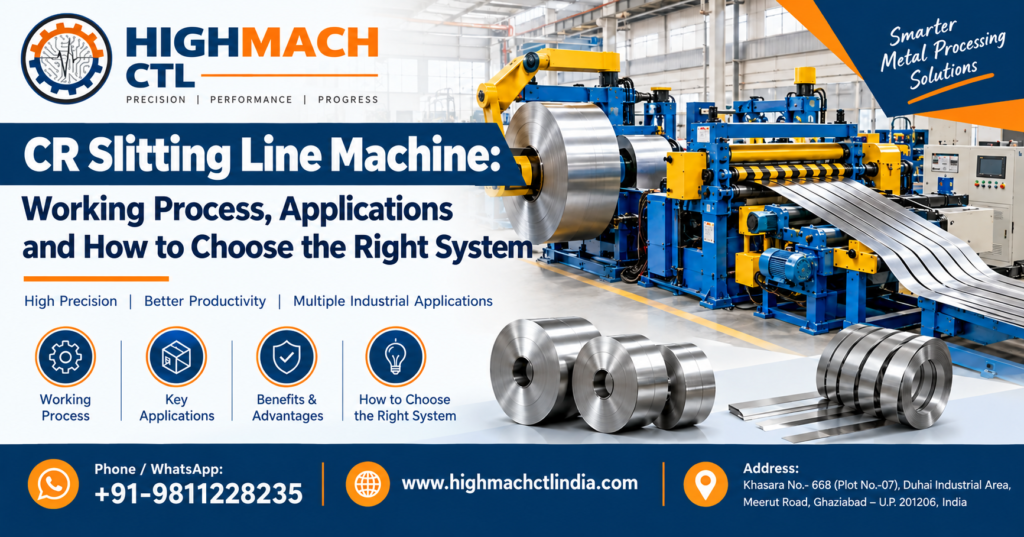
A CR slitting line machine is industrial equipment that cuts a wide cold rolled steel coil into several narrower strips of specified widths, then rewinds each strip into its own coil.
Cold rolled steel needs careful handling because its finished surface marks easily and downstream users expect dimensional consistency. Suitable tooling, accurate alignment and controlled strip tension all help the line deliver repeatable results.
It helps to separate slitting from cut-to-length (CTL) processing:
- Slitting divides a wide coil into multiple narrower strips.
- Cut-to-length processing cuts a continuous strip into flat sheets of specified lengths.
Which one you need depends on whether your business mainly requires narrow strips or flat sheets.
How Does a CR Slitting Line Machine Work?
The coil slitting process follows a clear sequence.
1. Coil loading. The coil is placed on the line using suitable material-handling equipment. Safe handling and correct alignment at this stage prevent damage to the coil and set up stable feeding.
2. Decoiling. The decoiler holds the coil and unwinds it in a controlled way, giving the line a continuous supply of material.
3. Guiding and preparation. Entry guides, and where needed levelling or flattening arrangements, prepare the strip for cutting. The exact configuration depends on the material and production requirements.
4. Precision slitting. Rotary slitting knives divide the wide strip into narrower ones. Knife positioning, tooling condition and appropriate shear clearance all influence strip-width accuracy and edge quality.
5. Scrap edge handling. Trim scrap from the edges is collected or wound by a scrap-handling system, which keeps the production area organised and the process uninterrupted.
6. Recoiling. The slit strips are rewound into separate coils. Controlled tension supports uniform winding and helps reduce problems such as telescoping or uneven edges.
7. Inspection and quality checks. Strip width, edge condition, surface finish and coil winding are checked before the material moves to the next stage.
Main Components of a CR Slitting Line
A typical line includes:
- Coil car or loading arrangement to position the coil safely
- Decoiler (uncoiler) to unwind the coil under control
- Entry guides and pinch rolls, where applicable, to steer and feed the strip
- Slitter head and precision knives that perform the cutting
- Spacers and tooling arrangements that set the strip widths
- Scrap winder to handle edge trim
- Tension-control and separator systems to keep strips stable and apart during rewinding
- Recoiler to wind the finished strips
- Electrical controls and safety systems to operate the line and protect operators
The exact configuration varies with coil specifications, production targets, material requirements and machine design.
Applications Across Different Industries
Slit cold rolled steel strips feed a wide range of industries:
- Automotive manufacturing: strips for stamping, forming and component production
- Electrical equipment: material for selected enclosures, cabinets and components
- Home appliances: steel strips for compatible panels and parts
- Metal fabrication: raw material for forming, bending, stamping and similar operations
- Steel service centres: processing master coils into customer-specific widths for downstream buyers
- Furniture and storage systems: strips for suitable frames, panels and formed metal products
The final application always depends on steel grade, thickness, surface requirements and customer specifications.
Benefits of Using the Right Slitting System
A well-matched and properly configured machine can support:
- Consistent strip-width control
- Better material utilisation through appropriate slitting layouts
- Improved control of edge quality
- Less unnecessary handling between process stages
- Repeatable output for production orders
- Flexibility for different strip-width requirements
- A smoother workflow in steel coil processing operations
Actual results depend on machine configuration, tooling, material characteristics, maintenance and operator practices, so outcomes should be confirmed against your own requirements rather than assumed.
CR Slitting Line Machine vs Cold Rolled Steel CTL Line
The two systems are related but serve different purposes. The table below summarises the differences.
| Comparison Factor | CR Slitting Line Machine | Cold Rolled Steel CTL Line |
| Main purpose | Divides wide coils into narrower strips | Cuts continuous coil material into sheets of specified lengths |
| Typical output | Multiple narrow steel strips or slit coils | Flat sheets of defined lengths |
| Primary cutting operation | Rotary slitting | Cross-cutting or shearing |
| Important quality considerations | Strip width, edge quality, winding and surface condition | Sheet length, flatness, squareness and surface condition |
| Typical downstream uses | Strip processing, stamping and forming | Sheet fabrication, panel production and blank preparation |
| Key selection factors | Strip-width combinations, knife setup, coil dimensions and tension control | Required sheet dimensions, levelling needs, cutting accuracy and production volume |
A Cold Rolled Steel CTL Line suits businesses whose downstream work starts with flat sheets or blanks. A slitting line suits those who need narrow strips or coils. Some operations use both..
How to Choose the Right System
Use this checklist when evaluating a machine:
- Material specifications: confirm the steel grade, thickness range, coil width, coil weight and surface requirements.
- Required strip widths: decide the width combinations and the number of strips needed from each master coil.
- Production volume: estimate daily or monthly output and how often you will change over between orders.
- Edge quality and tolerances: identify the accuracy and edge condition your downstream processes demand.
- Tooling and setup: ask about knife arrangements, spacer selection, changeover procedures and tooling maintenance.
- Tension and recoiling: check that the system can hold stable tension and produce suitable winding quality for your material.
- Automation and controls: evaluate automation level, operator requirements, production monitoring and safety provisions.
- Installation and maintenance: consider floor space, utilities, servicing needs, spare parts and after-sales support.
- Supplier evaluation: hold a technical discussion and verify the specifications against your real operating requirements before purchasing.
The best machine is the one that fits your material, output, quality and operational needs, not necessarily the one with the highest advertised speed.
Why Consider Highmach CTL?
Highmach CTL supplies industrial coil-processing machinery, including its slitting line for CR cold rolled steel. Prospective buyers can discuss their material specifications, desired strip widths, production volume and quality requirements with the team to understand which configuration may be appropriate for their operation.
Frequently Asked Questions
Can one CR slitting line machine handle every cold rolled steel grade and thickness?
Not necessarily. Suitability depends on the machine’s specified material range, thickness and width capacity, tooling and process configuration. Confirm compatibility with your actual coils before purchasing.
What is the difference between a slitting line and a CTL line?
A slitting line produces narrow strips or coils from a wide coil, while a CTL line produces flat sheets of set lengths.
What information should I share when requesting a quotation?
Share your steel grade, thickness and width range, coil weight, required strip widths, expected volume and tolerance requirements.
Does tooling affect strip quality?
Yes. Knife condition, spacer setup and shear clearance all influence width accuracy and edge quality, so tooling maintenance matters.
Conclusion
Understanding how a CR slitting line machine works, where slit strips are used and which factors matter in selection helps businesses make informed coil-processing decisions. Start with your material, strip widths, volume and quality needs, then match them to a machine configuration.
To learn more, explore the CR slitting line solution from Highmach CTL and get in touch to discuss your production requirements.
Contact Highmach CTL
- Email: info@highmatchctl.com
- Phone / WhatsApp: +91-9811228235
- Address: Khasara No.- 668 (Plot No.-07), Duhai Industrial Area, Meerut Road, Ghaziabad – U.P. 201206, India