
The Decision That Shapes Your Entire Production Line
Picture this: you’ve invested in a brand-new coil processing line. It arrives, gets installed, and within three months it’s running at inconsistent lengths, your scrap rate climbs, and the manufacturer’s phone goes to voicemail. Sound familiar? It’s a situation metal fabricators face more often than anyone admits.
Choosing a Coil Processing Machine Manufacturer is one of the highest-stakes purchasing decisions in metal processing. Get it right, and you have reliable throughput, tight tolerances, and a manufacturer who actually shows up when something goes wrong. Get it wrong, and you’re looking at costly downtime, expedited part orders, and a machine that underperforms for its entire lifecycle.
This guide walks you through everything — from understanding what coil processing machines actually do, to evaluating manufacturers step by step, spotting red flags early, and making a decision you’ll be confident about for years to come.
What is a Coil Processing Machine? (And Why the Manufacturer Matters)
A coil processing machine is industrial equipment that unwinds, straightens, feeds, and cuts metal coil stock — steel, aluminum, stainless steel, copper — into flat blanks or strips ready for stamping, forming, or fabrication downstream.
The most common types are:
- Cut-to-Length (CTL) Lines — Uncoil and cut to precise flat blank lengths
- Slitting Lines — Cut wide coil into narrower strips
- Straightener/Feeder Combinations — Remove coil set and feed press lines automatically
- Recoiling Systems — Rewind processed strips into tight coils
- Multi-Function Processing Lines — Combined systems for high-volume operations
Here’s the thing most buyers miss: two machines with near-identical spec sheets can perform completely differently. The difference is almost entirely in who built them — their component sourcing, engineering discipline, quality control process, and the level of support they provide after handover.
Common Coil Processing Machine Types at a Glance
| Machine Type | Primary Function | Common Industries | Key Spec to Evaluate |
| Cut-to-Length (CTL) Line | Cuts coil into flat blanks of set lengths | Automotive, appliance, construction | Length accuracy (±mm) |
| Slitting Line | Cuts wide coil into narrower strips | Tube making, rollforming, stamping | Strip width tolerance |
| Straightener/Feeder | Removes coil set; feeds presses | Progressive die stamping, transfer press | Feed accuracy per stroke |
| Recoiling System | Rewinds processed strip into coils | Service centers, processors | Max line speed & tension control |
| Multi-Function Line | Combined processing (CTL + slit) | High-mix, high-volume processors | Changeover time |
How to Evaluate a Coil Processing Machine Manufacturer: 7 Key Criteria
Let’s get practical. Here are the seven factors that separate genuinely capable manufacturers from the ones you’ll regret working with.
1. Engineering Experience in Your Industry
A manufacturer who builds machines for the automotive sector understands tolerances, line speeds, and material grades that a generalist supplier may not. Ask for references from customers in your specific industry — automotive, HVAC, construction supply, electronics — and follow up on those references.
2. Custom Engineering Capability
Most real-world applications don’t fit a catalog machine. You may have unusual coil dimensions, a specific material grade, or a downstream process that requires custom entry/exit automation. A capable manufacturer will ask probing questions about your application — not just your budget.
3. Build Quality and Component Sourcing
Ask what’s inside the machine. Name-brand PLCs (Allen-Bradley, Siemens), hardened precision-ground rollers, heavy-plate welded frames, and servo drive systems are hallmarks of quality. Generic or unbranded components on critical systems are a warning sign.
4. Documented Tolerance Specifications
Any manufacturer worth their salt will give you documented specs — length accuracy, flatness, strip width tolerance — in writing. Verbal assurances don’t mean anything when your press room is producing scrap.
5. After-Sales Support Structure
This is arguably the most important criterion. Find out: Is support domestic or offshore? What’s the lead time on spare parts? Is training included? Is there a preventive maintenance program? A machine with great specs but no support is a liability.
6. Safety Standards and Certifications
Coil processing lines operate under significant mechanical forces. Verify compliance with ISO 9001:2015, CE marking (where applicable), OSHA-compliant guarding, and UL/CSA electrical standards before committing.
7. Delivery and Project Management
A great machine delivered six months late can derail launch schedules and contract commitments. Ask about design reviews, Factory Acceptance Testing (FAT), and project milestone communication — all before you sign.
Manufacturer Evaluation Criteria — What to Ask & Why It Matters
| Evaluation Criteria | What to Ask the Manufacturer | Why It Matters |
| Engineering Experience | “Can you share references from our industry?” | Industry-specific knowledge reduces application risk |
| Customization | “Can you accommodate our coil specs and automation needs?” | Off-the-shelf machines rarely fit perfectly |
| Component Quality | “What PLC brand and roller grade do you use?” | Determines long-term reliability and serviceability |
| Tolerance Specs | “Can you provide written length and flatness tolerances?” | Critical for press room performance and scrap control |
| After-Sales Support | “Where is your service team based? What are part lead times?” | Determines real-world uptime over the machine’s life |
| Certifications | “Are you ISO 9001 certified? CE/UL compliant?” | Ensures safety, quality, and regulatory compliance |
| Project Management | “Do you offer FAT testing and milestone updates?” | Reduces delivery surprises and commissioning delays |
Step-by-Step Buying Process: From Shortlist to Signed Order
Buying a coil processing line isn’t like ordering off Amazon. Here’s how to navigate the process without leaving money on the table or committing to the wrong partner.
The Coil Processing Machine Buying Process — Step by Step
| Step | Action | What to Produce / Verify |
| Step 1 | Define your application requirements | Material type, coil dimensions, line speed, downstream process |
| Step 2 | Shortlist 3–5 manufacturers | Based on industry experience, certifications, and references |
| Step 3 | Issue a formal RFQ (Request for Quotation) | Include full application spec sheet; request itemized quotes |
| Step 4 | Evaluate quotations on value, not just price | Compare component specs, tolerances, warranty, and support terms |
| Step 5 | Visit the factory or request a virtual tour | Verify manufacturing capability and build quality firsthand |
| Step 6 | Negotiate terms and confirm delivery milestones | Payment schedule tied to FAT and delivery milestones |
| Step 7 | Attend Factory Acceptance Testing (FAT) | Sign off on performance before the machine ships |
| Step 8 | Commission on-site and train operators | Full runoff, documentation handover, and operator sign-off |
Best Practices When Choosing a Coil Processing Machine Manufacturer
Always get tolerances in writing. Verbal assurances on accuracy aren’t worth anything once the machine is running scrap.
Visit the factory before you buy. You’ll learn more in two hours on the floor than in ten hours of sales calls.
Call their existing customers. Ask specifically about after-sales support responsiveness — not just machine quality.
Tie payments to milestones. Never pay 100% upfront. Structure payments around design review, FAT, delivery, and commissioning.
Request a spare parts list with pricing. Know what critical components cost before the machine ever breaks down.
Ask about future-proofing. Can the machine be upgraded for higher speeds or additional automation as your business grows?
Common Mistakes Buyers Make (And How to Avoid Them)
Choosing on price alone. The cheapest machine almost never delivers the lowest total cost of ownership. Hidden costs in scrap, downtime, and support quickly erode any upfront savings.
Skipping the factory visit. A manufacturer who looks polished in a brochure may have a very different reality on the shop floor.
Not verifying references. “We have hundreds of happy customers” means nothing without names you can call.
Ignoring lead times. A 20-week lead time can collapse a project schedule. Confirm delivery dates in writing with penalty clauses where possible.
Overlooking control system compatibility. If the machine’s PLC can’t integrate with your existing press room automation, you’re looking at expensive custom programming later.
Buyer’s Checklist — Before You Sign the Purchase Order
| Checklist Item | Confirmed? | Notes |
| Application spec sheet provided to manufacturer | ☐ Yes ☐ No | Material, coil OD/ID/width/weight, speed requirements |
| Written tolerance specifications received | ☐ Yes ☐ No | Length accuracy, flatness, strip width |
| Component brand list obtained | ☐ Yes ☐ No | PLC, drives, roller grade |
| Customer references called | ☐ Yes ☐ No | Focus on after-sales support feedback |
| Factory visit completed | ☐ Yes ☐ No | In-person or virtual tour |
| ISO/CE/UL certifications verified | ☐ Yes ☐ No | Request documentation copies |
| Payment milestones agreed in writing | ☐ Yes ☐ No | Tied to FAT, delivery, commissioning |
| Spare parts list with pricing obtained | ☐ Yes ☐ No | Critical components for first 2 years |
| Operator training included in contract | ☐ Yes ☐ No | On-site or remote training confirmed |
| Warranty terms reviewed and agreed | ☐ Yes ☐ No | Duration, coverage scope, claim process |
Why Highmach CTL Is the Coil Processing Machine Manufacturer Trusted by Industry Leaders
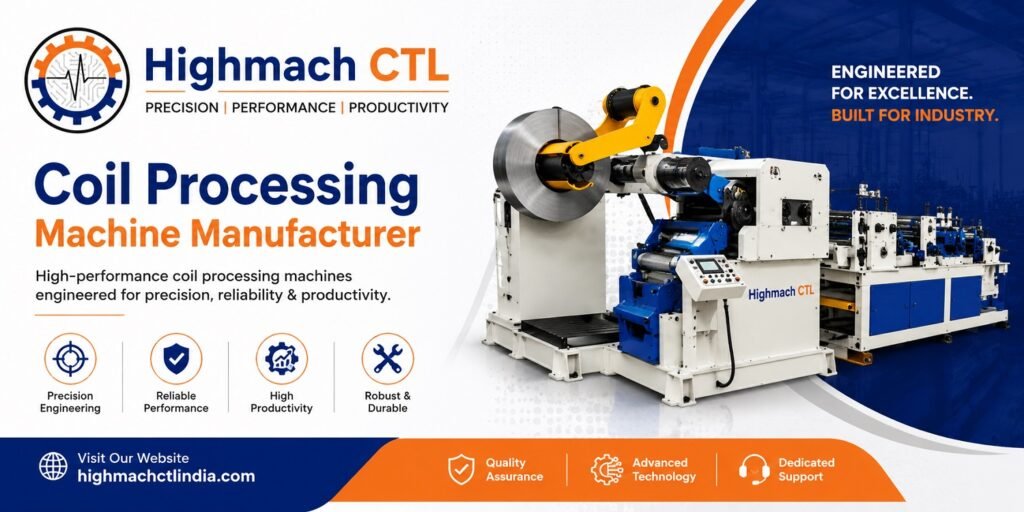
At Highmach CTL, we don’t sell general machinery — we specialize entirely in cut-to-length lines and coil processing systems. That focus means every machine we engineer is purpose-built for metal processing operations that can’t afford to compromise on accuracy or uptime.
Here’s what working with Highmach CTL actually looks like:
- Application-first engineering: We start with your coil specs, downstream process, and production targets — not a catalog page.
- Heavy-frame construction: Built for long-term rigidity and dimensional stability under continuous production loads.
- Name-brand control systems: Full integration capability with your existing press room automation.
- Transparent documentation: Written tolerance specs, full BOM, and FAT sign-off before a machine leaves our facility.
- Real support: From commissioning through the machine’s working life — not just during the warranty period.
Frequently Asked Questions
Q1: What is the most important factor when choosing a coil processing machine manufacturer?
After-sales support and engineering experience are the two most critical factors. A machine is only as good as the manufacturer’s ability to keep it running. Look for domestic service capability, fast spare parts availability, and a clear warranty policy before committing to any supplier.
Q2: How long does it take to manufacture a custom coil processing line?
Most custom-engineered coil processing lines take 12 to 24 weeks from order confirmation to delivery, depending on complexity. Simpler systems may be available in 8–10 weeks. Always confirm lead times in writing, tied to specific project milestones.
Q3: What’s the difference between a CTL line and a slitting line?
A cut-to-length (CTL) line cuts coil stock into flat blanks of specified lengths. A slitting line cuts wide coil stock into narrower strips. Many operations require both — CTL lines for press-ready blanks and slitting lines for strip-fed progressive dies or rollformers.
Q4: How do I verify a coil processing machine manufacturer’s quality?
Request a factory visit or virtual tour, call customer references in your industry, and review their ISO or quality certifications. Ask for their Factory Acceptance Testing (FAT) process documentation and written tolerance specifications — not just verbal assurances.
Q5: Can a coil processing machine integrate with my existing press room automation?
Yes — modern coil processing lines can integrate with robotic press feeds, stamping presses, and ERP/MES systems through compatible PLC platforms. Specify your automation requirements early in the engineering phase so the manufacturer can design the control architecture accordingly.
Q6: What should I watch out for when comparing quotes from multiple manufacturers?
Don’t just compare the bottom line. Compare component specifications (PLC brand, roller grade, drive systems), documented tolerances, warranty coverage, spare parts availability, and whether commissioning and training are included. A detailed, transparent quote reflects manufacturing confidence.
Conclusion: The Right Manufacturer Is a Production Partner, Not Just a Vendor
Choosing a coil processing machine manufacturer isn’t a transaction — it’s a long-term commitment that will shape your production capability, scrap rate, uptime, and product quality for the life of the equipment.
The manufacturers worth working with are the ones who ask hard questions about your application before they quote, provide documented specs without being asked, invite you to their factory, and answer the phone after delivery.
Highmach CTL was built on exactly that philosophy. If you’re serious about coil processing that performs reliably at the tolerances your operation demands, we’d like to talk.
Ready to Build Your Ideal Coil Processing Line?
Talk to a Highmach CTL engineer today. We’ll evaluate your application, recommend the right solution, and give you a transparent quote — no pressure, no generic catalog answers.
Call Us Now – +91-9811228235
Visit Our Website – https://highmachctlindia.com/