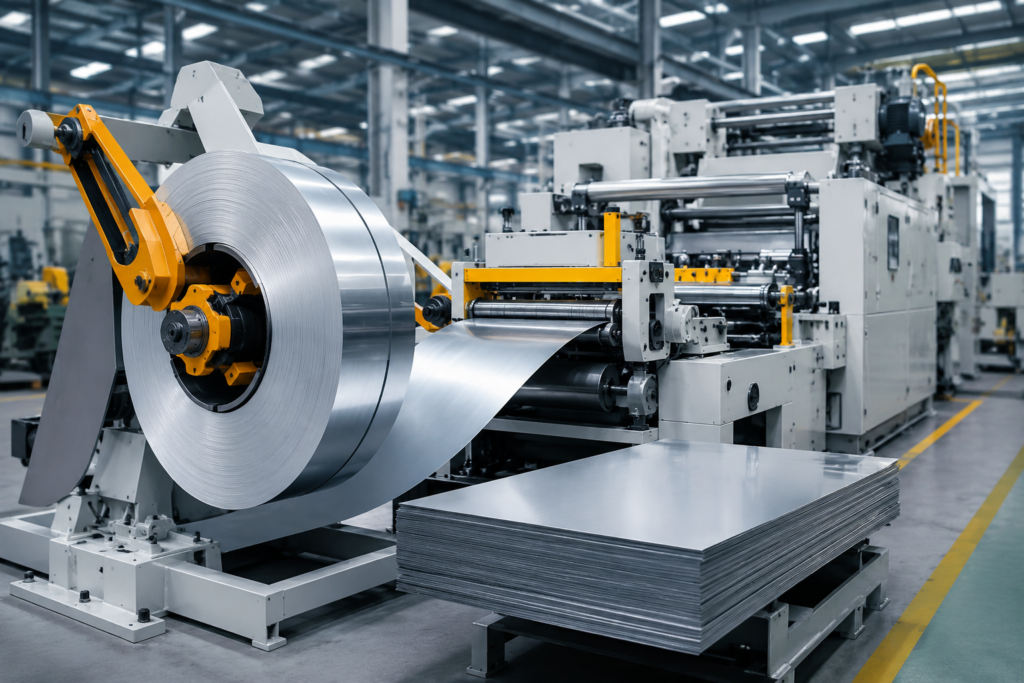
A Sheet Metal Processing Machine improves production quality and speed by automating cutting, leveling, feeding, and forming processes with high precision. It reduces manual errors, ensures consistent dimensions, minimizes material waste, and significantly increases output speed. Modern machines also integrate CNC controls and smart sensors, enabling manufacturers to achieve faster turnaround times with superior product accuracy and repeatability.
In modern manufacturing, efficiency and precision define competitiveness. A Sheet Metal Processing Machine plays a critical role in achieving both by automating and optimizing the transformation of raw metal sheets into usable components. These machines help industries reduce production time, improve dimensional accuracy, and maintain consistent product quality across large-scale operations.
For manufacturers dealing with steel coils, automotive parts, construction materials, or appliances, investing in advanced sheet metal processing systems is no longer optional—it is essential for survival in a highly competitive industrial landscape.
In this blog, we will explore how sheet metal processing machines improve production quality and speed, their core technologies, and why companies like Highmach CTL are shaping the future of industrial fabrication.
What is a Sheet Metal Processing Machine?
A Sheet Metal Processing Machine is industrial equipment designed to cut, level, form, or process metal sheets and coils into specific sizes and shapes required for manufacturing.
Common Types Include:
- Cut-to-Length (CTL) lines
- Slitting lines
- Coil feeding systems
- Leveling machines
- Shearing machines
- Stacking systems
These machines work together or individually to convert raw metal coils into finished sheets ready for downstream production.
How Sheet Metal Processing Machines Improve Production Quality
1. High Dimensional Accuracy
One of the biggest advantages is precision. Automated systems eliminate human error and ensure every sheet is cut to exact specifications. This is especially important in industries like automotive and aerospace, where even minor deviations can cause assembly issues.
2. Consistent Surface Quality
Modern machines use advanced leveling and feeding mechanisms to reduce surface defects such as waviness, bending, or scratches. This ensures uniformity across batches.
3. Reduced Material Waste
By optimizing cutting patterns and coil usage, these machines minimize scrap generation. This directly improves cost efficiency and sustainability.
4. Improved Repeatability
Once parameters are set, machines can replicate the same output thousands of times without variation. This consistency is crucial for mass production.
5. Better Edge Quality
High-speed shearing and precision blades ensure clean, burr-free edges, reducing the need for secondary finishing processes.
How Sheet Metal Processing Machines Improve Production Speed
1. Continuous High-Speed Operation
Unlike manual processing, these machines operate continuously with minimal downtime, significantly increasing output.
2. Automated Feeding and Handling
Automated coil feeding systems reduce manual labor and speed up the entire workflow from input to output.
3. Integrated Processing Lines
Modern systems combine multiple operations—uncoiling, leveling, cutting, and stacking—into a single production line, eliminating delays between stages.
4. Reduced Setup Time
Digital controls and CNC systems allow quick changeovers between different sheet sizes and materials.
5. Real-Time Monitoring
Sensors and PLC-based systems monitor performance in real time, reducing breakdowns and maintaining consistent production flow.
Key Technologies Behind Modern Sheet Metal Processing Machines
CNC Control Systems
Enable precise programming of cutting lengths, speed, and material handling.
Servo Motors
Provide high-speed, accurate motion control for feeding and cutting operations.
Hydraulic Systems
Ensure strong, stable cutting force for thick metal sheets.
Automatic Stacking Systems
Organize finished sheets efficiently, reducing manual handling time.
Smart Sensors
Detect misalignment, material thickness, and tension variations for better quality control.
Industrial Applications of Sheet Metal Processing Machines
Sheet metal processing technology is widely used across industries:
- Automotive manufacturing
- Construction and infrastructure
- Electrical appliance production
- HVAC systems
- Steel fabrication units
- Shipbuilding and heavy machinery
Each of these industries relies on precision-cut sheets for downstream assembly and product development.
Benefits of Using Sheet Metal Processing Machines
| Benefit Area | Impact on Manufacturing |
| Productivity | Higher output in less time |
| Quality | Consistent and defect-free sheets |
| Cost Efficiency | Reduced labor and material waste |
| Safety | Less manual handling risk |
| Scalability | Easy to scale production volume |
Expert Insights: Why Automation is the Future
Industry experts agree that automation in sheet metal processing is no longer a luxury—it is a necessity. As global demand increases, manufacturers must adopt systems that can deliver:
- Faster production cycles
- Lower operational costs
- Higher precision standards
- Real-time quality control
Companies like Highmach CTL are integrating advanced engineering with automation to help industries transition smoothly from manual to intelligent production systems.
Practical Tips for Choosing the Right Sheet Metal Processing Machine
1. Evaluate Material Type
Ensure the machine supports the thickness and type of metal you process.
2. Check Speed vs Accuracy Balance
High speed should not compromise precision.
3. Look for Automation Features
CNC control, servo feeding, and smart diagnostics improve efficiency.
4. Consider Maintenance Requirements
Choose machines with easy servicing and durable components.
5. Assess Scalability
Your production needs may grow, so choose a flexible system.
Common Challenges Solved by Sheet Metal Processing Machines
- Inconsistent manual cutting
- High labor dependency
- Excess material wastage
- Slow production cycles
- Quality variation across batches
By automating these processes, manufacturers achieve stable and scalable production.
Why Highmach CTL is a Trusted Name in Sheet Metal Processing
With a strong focus on engineering precision and industrial innovation, Highmach CTL delivers advanced sheet metal processing solutions designed for high-performance manufacturing environments.
Their systems are built to improve:
- Production efficiency
- Operational reliability
- Output consistency
- Long-term cost savings
Frequently Asked Questions (FAQs)
1. What is a Sheet Metal Processing Machine used for?
It is used to cut, level, and process metal sheets or coils into precise sizes for industrial manufacturing applications.
2. How does it improve production speed?
It automates cutting, feeding, and stacking processes, reducing manual intervention and increasing continuous output.
3. Does it improve product quality?
Yes, it ensures uniform thickness, accurate dimensions, and smooth edges with minimal defects.
4. Which industries use sheet metal processing machines?
Industries like automotive, construction, HVAC, electrical appliances, and steel fabrication widely use them.
5. What should I consider before buying one?
Consider material type, automation level, production speed, maintenance needs, and scalability.
Conclusion
A Sheet Metal Processing Machine is a cornerstone of modern manufacturing, offering unmatched improvements in both production quality and speed. By automating complex metal forming and cutting processes, industries can achieve higher accuracy, reduced waste, and significantly faster output.
As manufacturing continues to evolve, investing in advanced machinery is essential for staying competitive in the global market.
Call to Action
Looking to upgrade your manufacturing efficiency with advanced sheet metal processing technology?
Connect with Highmach CTL today for expert consultation, customized solutions, and high-performance industrial machinery designed to boost your production capabilities.